Best Fixed Deposit Interest Rates in India (2026): Compare Top Bank FD Rates
────────────────────────────────────
✓ Last Updated: June 26, 2026
✓ Reviewed by: Priya, CFP®
✓ Reading Time: 18 min
────────────────────────────────────
Introduction: Why FD Rates Matter More Than Ever in 2026
Fixed deposits remain one of India’s most trusted savings instruments — and for good reason. Whether you are building an emergency fund, saving for a goal, or securing retirement income, an FD gives you a guaranteed return with zero market risk.
But here is what most people get wrong: they walk into their home bank, accept whatever rate is offered, and sign up. In 2026, that decision could cost you 1.5% to 2.5% in annual returns — a significant difference when you are investing ₹5 lakh or more.
As of June 2026, the range is remarkably wide. India’s scheduled banks are offering FD interest rates anywhere from 2.50% to 8.10% per annum for regular depositors, depending on the bank, tenure, and deposit type. Small finance banks are leading the rate charts, while large public sector banks offer the safety of government backing at comparatively lower rates.
This guide does the comparison work for you — updated FD rates, category-by-category breakdowns, senior citizen rates, tax-saving FD rules, and a practical framework for choosing the right FD for your situation.
Latest FD Interest Rates in India (June 2026)
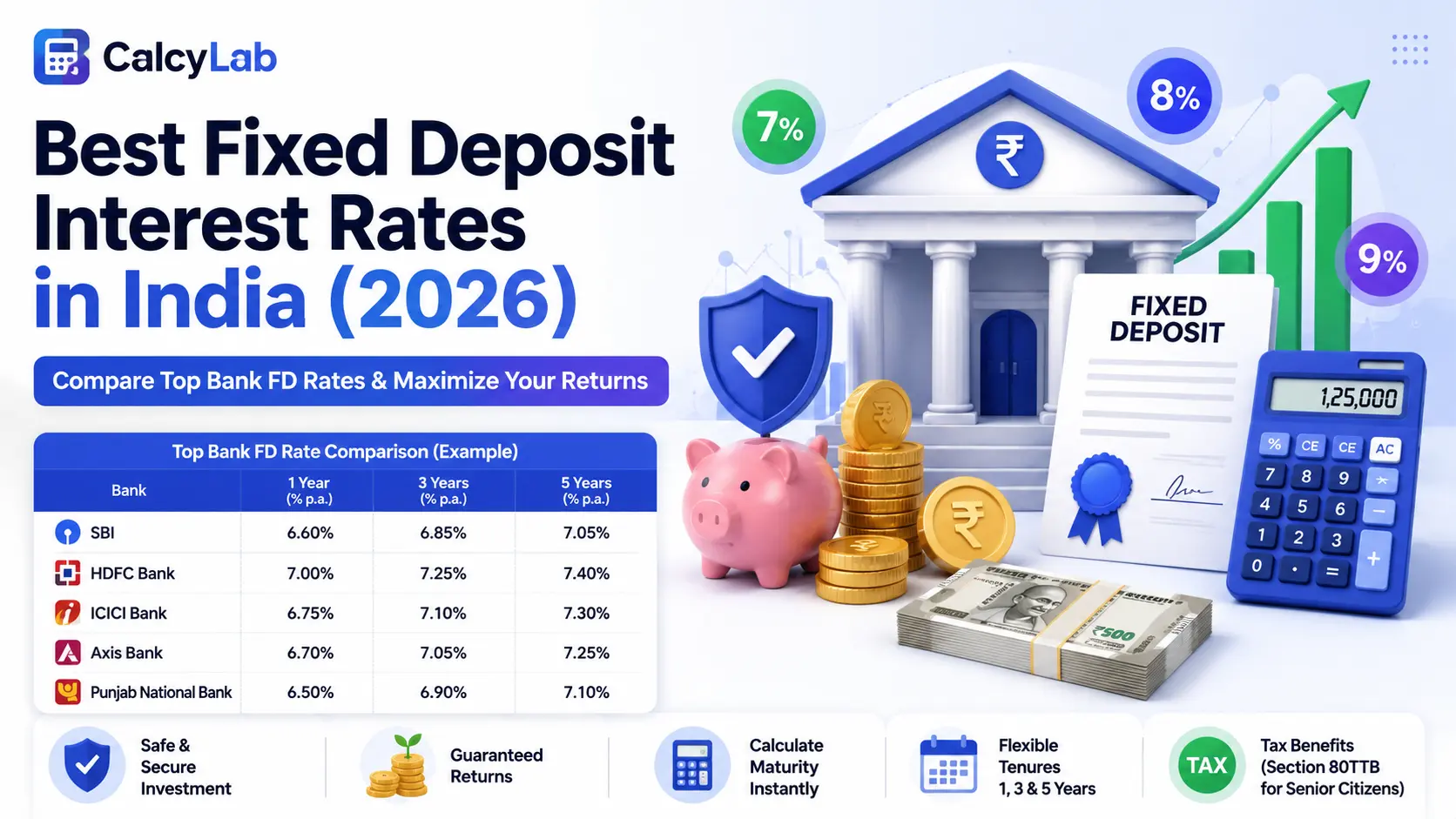
The table below gives a bird’s-eye view of the maximum FD rates currently offered across major bank categories. Rates apply to deposits below ₹3 crore.
| Bank Category | Max Rate (General) | Max Rate (Senior Citizens) |
|---|---|---|
| Public Sector Banks | Up to 6.85% | Up to 7.35% |
| Private Sector Banks | Up to 7.50% | Up to 8.25% |
| Small Finance Banks | Up to 8.10% | Up to 8.60% |
| NBFCs | Up to 7.75% | Up to 9.35% |
Rates as of June 2026. Subject to change. Verify at official bank websites before investing.
Before diving deeper into each category, use the FD Calculator on CalcyLab to run exact maturity projections for any amount, tenure, and interest rate. It handles both simple and compound interest scenarios.
Best Public Sector Bank FD Rates (June 2026)
Public sector banks are preferred by conservative investors for the implicit backing of the government and the security of DICGC insurance of up to ₹5 lakh per depositor per bank. Rates are moderate but stable.
| Bank | Highest FD Rate (General) | Best Tenure |
|---|---|---|
| Punjab & Sind Bank | 6.85% | Special tenure |
| Indian Bank | 6.80% | Select tenures |
| Bank of Baroda | 6.75% | Select tenures |
| Bank of India | 6.70% | Select tenures |
| Union Bank of India | 6.65% | Select tenures |
| Bank of Maharashtra | 6.65% | Select tenures |
| State Bank of India | 6.45% | 1–3 years |
| Canara Bank | 6.70% | Select tenures |
Note on SBI: SBI’s Amrit Vrishti special 444-day scheme offers 6.45% for general customers and 6.95% for senior citizens — worth considering for those seeking a specific short-to-medium tenure.
Best Private Sector Bank FD Rates (June 2026)
Private banks typically offer more competitive rates than public sector peers, though they lack the implicit government guarantee.
| Bank | Highest FD Rate (General) | Senior Citizen Rate |
|---|---|---|
| DCB Bank | 7.50% | ~8.00% |
| IDFC FIRST Bank | 7.35% | ~7.85% |
| CSB Bank | 7.35% | ~7.85% |
| Jammu & Kashmir Bank | 7.30% | ~7.80% |
| Yes Bank | 7.25% | Up to 8.00% |
| City Union Bank | 7.25% | ~7.75% |
| Dhanlaxmi Bank | 7.25% | ~7.75% |
| Bandhan Bank | 7.15% | Up to 7.90% |
| HDFC Bank | 6.50% | 6.95% |
| ICICI Bank | 6.50% | ~7.00% |
| Axis Bank | 6.45% | ~6.95% |
Large private banks like HDFC, ICICI, and Axis offer lower rates but come with superior digital infrastructure, branch network, and brand trust.
Best Small Finance Bank FD Rates (June 2026)
Small finance banks (SFBs) consistently offer the highest FD rates in India. They are regulated by the RBI, and deposits up to ₹5 lakh are insured by DICGC — the same protection you get with a commercial bank.
| Small Finance Bank | Max Rate (General) | Max Rate (Senior Citizens) |
|---|---|---|
| Suryoday Small Finance Bank | 8.10% | 8.60% |
| Utkarsh Small Finance Bank | 8.10% | 8.60% |
| Shivalik Small Finance Bank | 8.00% | 8.50% |
| Equitas Small Finance Bank | 8.00% | 8.50% |
| Jana Small Finance Bank | 7.77% | ~8.27% |
| ESAF Small Finance Bank | 7.75% | ~8.25% |
| Ujjivan Small Finance Bank | 7.55% | ~8.05% |
| AU Small Finance Bank | 7.40% | ~7.90% |
Important: While SFB rates look attractive, spread large deposits across multiple banks so each account stays within the ₹5 lakh DICGC insurance limit. Never concentrate more than ₹5 lakh with any single institution purely for rate-chasing.
Senior Citizen FD Rates in India (2026)
Senior citizens — those aged 60 and above — receive an additional 0.25% to 0.75% per annum over regular FD rates. Most banks offer 0.50% extra, while some like Bandhan Bank and Yes Bank extend 0.75% additional benefit.
Under Section 80TTB of the Income Tax Act, senior citizens can claim a deduction of up to ₹50,000 per financial year on interest income from bank deposits, post office deposits, and recurring deposits — making FDs particularly tax-efficient for retirees.
| Bank | Regular Rate | Senior Citizen Rate | Extra Benefit |
|---|---|---|---|
| Suryoday SFB | 8.10% | 8.60% | +0.50% |
| Utkarsh SFB | 8.10% | 8.60% | +0.50% |
| DCB Bank | 7.50% | ~8.00% | +0.50% |
| Bandhan Bank | 7.15% | 7.90% | +0.75% |
| Yes Bank | 7.25% | 8.00% | +0.75% |
| IDFC FIRST Bank | 7.35% | 7.85% | +0.50% |
| SBI (Amrit Vrishti) | 6.45% | 6.95% | +0.50% |
| HDFC Bank | 6.50% | 6.95% | +0.50% |
| ICICI Bank | 6.50% | ~7.00% | +0.50% |
Super senior citizens (80 years and above) get an additional top-up at select banks like SBI and Indian Bank.
Highest 1-Year FD Rates (June 2026)
Short-tenure deposits suit investors who expect rate changes or need liquidity within a year.
| Bank | 1-Year FD Rate (General) |
|---|---|
| DCB Bank | ~7.10% |
| IDFC FIRST Bank | ~7.00% |
| Yes Bank | ~7.00% |
| Bandhan Bank | ~6.75% |
| HDFC Bank | ~6.60% |
| ICICI Bank | ~6.60% |
| SBI | ~6.80% (special tenure) |
| Suryoday SFB | ~7.00% |
Highest 3-Year FD Rates (June 2026)
Three-year FDs are the sweet spot for many investors — long enough to earn strong compound growth, short enough to plan around changing life goals.
If you’re unsure which duration is right for your goals, read our FD Tenure Explained guide to understand how different tenures affect returns, liquidity, and interest rates.
| Bank | 3-Year FD Rate (General) |
|---|---|
| DCB Bank | ~7.50% |
| Suryoday SFB | ~8.05% |
| Utkarsh SFB | ~8.05% |
| IDFC FIRST Bank | ~7.25% |
| Yes Bank | ~7.25% |
| HDFC Bank | ~6.50% |
| ICICI Bank | ~6.50% |
| SBI | ~6.45% |
Highest 5-Year FD Rates (June 2026)
Five-year FDs are ideal for long-term goals and are the only tenure eligible for Section 80C tax deductions under the Tax Saving FD category.
| Bank | 5-Year FD Rate (General) | Senior Citizen Rate |
|---|---|---|
| Suryoday SFB | 8.05% | 8.10% |
| Utkarsh SFB | 8.05% | 8.10% |
| DCB Bank | ~7.50% | ~8.00% |
| Yes Bank | ~7.25% | ~8.00% |
| IDFC FIRST Bank | ~7.25% | ~7.75% |
| HDFC Bank | 6.50% (Tax Saver) | 6.95% |
| ICICI Bank | 6.50% (Tax Saver) | ~7.00% |
| SBI | 6.05% (Tax Saver) | 7.05% |
Tax Saving FD Rates and Rules
A Tax Saving FD is a 5-year fixed deposit that qualifies for a deduction of up to ₹1.5 lakh per financial year under Section 80C of the Income Tax Act (applicable under the old tax regime).
Key Rules to Know:
- Lock-in: 5 years — no premature withdrawal is allowed, unlike regular FDs.
- Tax on interest: The principal qualifies for Section 80C deduction, but the interest you earn is fully taxable at your income slab rate.
- TDS: Banks deduct TDS at 10% if your total interest across FDs in a financial year exceeds ₹40,000 (₹1 lakh for senior citizens). Submit Form 15G (or 15H for seniors) if your income falls below the taxable threshold.
- Nomination: Allowed. Joint holding is permitted, but the Section 80C benefit goes only to the first holder.
- Loan against FD: Not permitted during the 5-year lock-in period.
| Bank | Tax Saving FD Rate (General) | Senior Citizen Rate |
|---|---|---|
| Jana SFB | ~7.50% | ~8.00% |
| Ujjivan SFB | ~7.50% | ~8.00% |
| Yes Bank | ~7.25% | ~8.00% |
| IDFC FIRST Bank | ~7.25% | ~7.75% |
| HDFC Bank | 6.50% | 6.95% |
| ICICI Bank | 6.50% | ~7.00% |
| SBI | 6.05% | 7.05% |
If you are in the 30% tax bracket and choose the old regime, investing ₹1.5 lakh in a Tax Saving FD saves you ₹46,800 in tax — making the effective return considerably higher than the stated rate.
Remember that while Tax Saving FDs can reduce your taxable income under Section 80C (old regime), the interest earned remains taxable. Learn more in our complete guide on FD Tax Explained.
How Banks Calculate FD Interest
Understanding the mechanics helps you make smarter choices between banks and payout options.
Simple Interest (Non-Cumulative FD): Used when interest is paid out periodically — monthly, quarterly, or annually.
Formula: Interest = Principal × Rate × Time / 100
Example: ₹1,00,000 at 7% for 1 year = ₹7,000 interest.
Compound Interest (Cumulative FD): Most banks in India compound FD interest quarterly, even on annual-rate FDs. Your interest earned in Quarter 1 becomes part of the principal for Quarter 2.
Formula: A = P × (1 + r/n)^(n×t)
Where: P = Principal, r = annual rate (decimal), n = compounding frequency per year, t = tenure in years.
Example: ₹1,00,000 at 7% p.a. compounded quarterly for 3 years: A = 1,00,000 × (1 + 0.07/4)^(4×3) = ₹1,23,144
That is ₹544 more than simple annual compounding — and even more significant at larger amounts or longer tenures.
To save time and run multiple scenarios instantly, the CalcyLab FD Calculator handles both simple and compound interest across any tenure with one click. You can also learn the full mechanics of compounding in Compound Interest Explained for Beginners.
Factors That Affect FD Interest Rates
Several forces determine what rate a bank will offer you on any given day:
1. RBI Repo Rate The repo rate is the interest rate at which the RBI lends money to commercial banks. When the repo rate rises, banks raise FD rates to attract deposits. When it falls, FD rates follow. This is the single largest driver of FD rate movements across India.
2. Liquidity Position of the Bank Banks that need more deposits to meet lending demand tend to raise FD rates to attract funds. Banks sitting on excess liquidity reduce rates.
3. Inflation Higher inflation reduces the real return on FDs. Banks adjust nominal rates upward to maintain positive real yields and attract depositors.
4. Bank Size and Credit Rating Large commercial banks with deep deposit bases (SBI, HDFC, ICICI) can afford to offer lower rates because they attract deposits by reputation alone. Smaller banks and SFBs offer higher rates to compete.
5. Tenure Longer tenures generally earn higher rates — though not always. Banks sometimes offer special short-term rates on specific tenures (like 444 days or 555 days) to match their asset-liability profile.
6. Deposit Amount Bulk deposits above ₹2 crore sometimes carry negotiated or higher rates. For retail investors below ₹3 crore, the standard rate card applies.
How the RBI Repo Rate Affects Your FD Returns
When the RBI’s Monetary Policy Committee (MPC) meets to set the repo rate, it directly ripples through India’s FD market. Here’s the transmission chain:
RBI raises repo rate → Banks’ cost of borrowing rises → Banks raise lending rates (home loans, personal loans become costlier) → To attract depositors and fund lending, banks raise FD rates too.
Conversely, when the RBI cuts rates to stimulate economic growth — as it has done multiple times in recent years — FD rates soften.
What this means for you: If the RBI signals rate cuts ahead, locking in long-tenure FDs before the cuts is a smart move. If rate hikes are expected, shorter-tenure FDs give you flexibility to reinvest at higher rates when they arrive. For a deeper understanding of how FDs work in this context, see What Is a Fixed Deposit and How Does It Work?
How to Choose the Best FD for Your Situation
There is no universal answer to “which is the best bank for FD.” Here is a practical decision framework:
| Your Priority | Best Choice |
|---|---|
| Maximum safety (government-backed) | SBI, Bank of Baroda, Canara Bank |
| Highest returns (risk-comfortable) | Suryoday SFB, Utkarsh SFB |
| Balance of rate + brand trust | DCB Bank, IDFC FIRST Bank, Yes Bank |
| Regular monthly income | Any bank with monthly payout option |
| Tax saving + guaranteed returns | Tax Saving FD (5-year) at HDFC, SBI, Jana SFB |
| Short tenure (3–12 months) | Compare rates quarterly; top private banks |
| Senior citizen with tax efficiency | SFB with high rate + Section 80TTB planning |
Step-by-step process:
- Fix your goal: growth (cumulative) or income (non-cumulative)?
- Fix your tenure based on when you’ll need the money.
- Compare the top 3–4 rates for that tenure from banks with DICGC cover.
- Check premature withdrawal penalty before committing.
- Confirm the total deposit per bank stays within ₹5 lakh for insurance purposes.
- Use the CalcyLab FD Calculator to verify projected maturity amounts.
FD vs Savings Account
| Feature | Fixed Deposit | Savings Account |
|---|---|---|
| Interest Rate | 4.50%–8.10% | 2.50%–4.00% |
| Liquidity | Low (lock-in) | Instant withdrawal |
| Returns | Guaranteed | Variable |
| Tax | Interest fully taxable | Same |
| Ideal For | Surplus funds, goals | Daily transactions, emergency |
Verdict: A savings account is your operational account; an FD is where idle money should go the moment you know you won’t need it for a defined period.
If you’re in the United States or comparing banking terms across countries, you might notice that fixed deposits are called Certificates of Deposit (CDs) in the USA. While they work similarly, there are some important differences in features, insurance, and interest rates. Learn what a Fixed Deposit is called in the USA before choosing the right savings option.
Learn what a Fixed Deposit is called in the USA
FD vs Recurring Deposit (RD)
| Feature | FD | RD |
|---|---|---|
| Investment Style | One-time lump sum | Monthly instalments |
| Interest Rate | Slightly higher | Slightly lower |
| Flexibility | Fixed amount upfront | Suits regular savers |
| Tax | Fully taxable | Fully taxable |
| Best For | Windfall, bonus, matured proceeds | Salaried individuals building a habit |
For a detailed RD projection, try the RD Calculator on CalcyLab.
FD vs SIP (Mutual Funds)
| Feature | FD | SIP (Equity Mutual Fund) |
|---|---|---|
| Returns | Fixed 5%–8.10% | Market-linked, historically 10%–14% |
| Risk | Zero | Moderate to high |
| Capital Safety | Guaranteed | Not guaranteed |
| Tax Efficiency | Fully taxable interest | LTCG taxed at 12.5% above ₹1.25 lakh |
| Liquidity | Penalty on early exit | Redeemable in 1–3 days |
| Ideal For | Risk-averse, near-term goals | Long-term wealth creation (7+ years) |
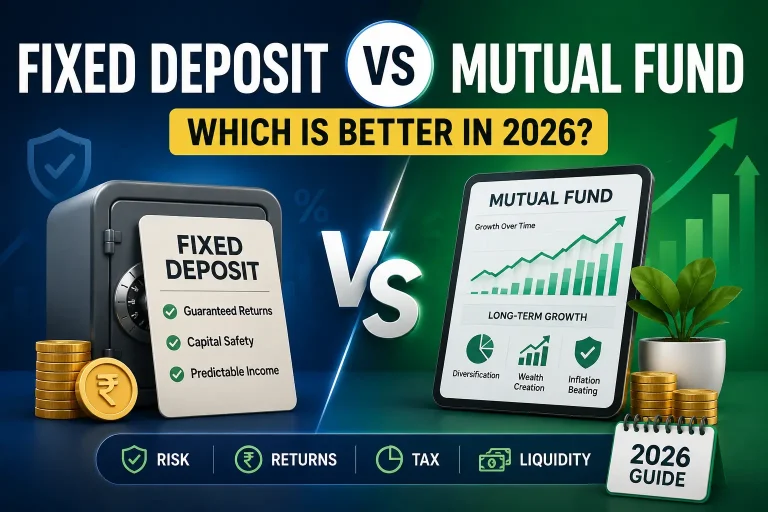
The honest view: Over a 10-year horizon, a well-chosen equity SIP has historically outperformed FDs significantly on a post-tax, inflation-adjusted basis. But FDs serve a different purpose — capital protection, not wealth multiplication. For a detailed side-by-side analysis, read Fixed Deposit vs Mutual Fund
FD vs PPF (Public Provident Fund)
| Feature | FD | PPF |
|---|---|---|
| Current Rate | Up to 8.10% | 7.10% (Q1 FY 2026–27) |
| Lock-in | 7 days to 10 years | 15 years |
| Tax on Interest | Fully taxable | Tax-free |
| Section 80C | Only Tax Saving FD | Yes (all contributions) |
| Liquidity | Premature exit with penalty | Partial withdrawal from Year 7 |
| Risk | Zero | Zero |
Key insight: PPF’s EEE (Exempt-Exempt-Exempt) status — tax-free contribution, growth, and maturity — makes it hard to beat on a post-tax basis for long-term goals despite its lower nominal rate. FD wins on flexibility. For retirement or 15-year goals, PPF is superior. For 1–5 year goals, FD wins. Use the PPF Calculator to model your PPF corpus.
The FD Ladder Strategy: Maximise Returns Without Sacrificing Liquidity
One of the most underrated FD techniques is laddering. Instead of locking all your money in a single long-tenure FD, you split it across multiple FDs with staggered maturities.
Example with ₹5 lakh:
| FD | Amount | Tenure | Maturity |
|---|---|---|---|
| FD 1 | ₹1,00,000 | 1 year | June 2027 |
| FD 2 | ₹1,00,000 | 2 years | June 2028 |
| FD 3 | ₹1,00,000 | 3 years | June 2029 |
| FD 4 | ₹1,00,000 | 4 years | June 2030 |
| FD 5 | ₹1,00,000 | 5 years | June 2031 |
Benefits:
- Every year, one FD matures, giving you liquidity.
- Each matured FD gets reinvested at the new prevailing rate — so you automatically benefit from any rate increases.
- You avoid the risk of breaking a large single FD prematurely (which attracts a penalty).
- DICGC risk is managed if FDs are placed across multiple banks.
Common FD Mistakes to Avoid
1. Not comparing rates before investing The difference between SBI’s 6.45% and Suryoday SFB’s 8.10% on ₹3 lakh over 3 years is approximately ₹14,000 in additional interest. That is not trivial.
2. Breaking FDs prematurely Most banks deduct 0.50% to 1.00% from the applicable rate if you close an FD before maturity. This often wipes out 1–2 months of interest earned.
3. Ignoring TDS If your FD interest crosses ₹40,000 in a year (₹1 lakh for seniors), TDS is deducted at 10%. Submit Form 15G/15H if eligible to avoid unnecessary cash flow impact and avoid the effort of claiming a refund later.
4. Keeping more than ₹5 lakh in a single bank DICGC insures up to ₹5 lakh per depositor per bank (principal + interest combined). Beyond this, your money is not insured if the bank fails.
5. Ignoring the cumulative vs non-cumulative choice Cumulative (compound interest at maturity) grows faster. Non-cumulative (periodic payouts) gives cash flow but sacrifices compound growth. Choose based on whether you need income now or growth over time.
6. Auto-renewal without checking rates When an FD auto-renews, it often does so at the prevailing rate — which may be lower than your original rate. Set a calendar reminder for maturity dates and actively review.
FAQ — 20 Detailed Questions Answered
What is the highest FD interest rate in India in June 2026?
As of June 2026, Suryoday Small Finance Bank and Utkarsh Small Finance Bank offer the highest FD rate at 8.10% per annum for general depositors. For senior citizens, some SFBs offer up to 8.60%. NBFC rates go even higher — Muthoot Capital offers up to 9.10% for general citizens and 9.35% for senior citizens, though NBFCs are not covered under DICGC insurance.
Which is the best bank for FD in India in 2026?
There is no single “best” bank — it depends on your priorities. For maximum returns with DICGC safety: Suryoday SFB or Utkarsh SFB. For established brand trust with decent rates: DCB Bank or IDFC FIRST Bank. For government-backed safety: SBI or Bank of Baroda. For senior citizens with strong rate + safety: Bandhan Bank or Yes Bank.
Is a fixed deposit safe in a small finance bank?
Yes, as long as your deposit per bank stays within ₹5 lakh. Small finance banks are licensed and regulated by the RBI, and deposits are insured by the Deposit Insurance and Credit Guarantee Corporation (DICGC) up to ₹5 lakh per depositor per bank (principal + interest). Beyond this threshold, there is no insurance coverage, so spreading large amounts across multiple SFBs is wise.
What is the difference between cumulative and non-cumulative FD?
In a cumulative FD (also called a reinvestment FD), interest is compounded and paid at maturity along with the principal. This gives you the power of compound interest and is ideal for long-term wealth building. In a non-cumulative FD, interest is paid out at regular intervals — monthly, quarterly, half-yearly, or annually. This suits retirees or anyone needing a steady income stream from their savings.
How is FD interest taxed in India?
FD interest is classified as “Income from Other Sources” and added to your total annual income. It is taxed at your applicable income tax slab rate — 5%, 10%, 15%, 20%, or 30% depending on your bracket. Banks deduct TDS at 10% if your interest from a bank exceeds ₹40,000 in a financial year (₹1 lakh for senior citizens). If you do not provide your PAN, TDS is deducted at 20%. If your total income is below the taxable limit, submit Form 15G (for those below 60) or Form 15H (for senior citizens) at the start of each financial year to prevent TDS deduction.
What are the Section 80C benefits on a Tax Saving FD?
A 5-year Tax Saving FD allows you to claim a deduction of up to ₹1.5 lakh per financial year on the principal invested under Section 80C of the Income Tax Act — but only if you are under the old tax regime. Note that the interest earned on a Tax Saving FD is fully taxable. Also, premature withdrawal is not allowed during the 5-year lock-in period, and you cannot take a loan against it.
What is Section 80TTB, and who can claim it?
Section 80TTB of the Income Tax Act allows resident senior citizens (aged 60 and above) to claim a deduction of up to ₹50,000 per financial year on interest income from savings accounts, fixed deposits, and recurring deposits held with banks, post offices, or cooperative banks. This is available only to senior citizens and only under the old tax regime. It is in addition to the Section 80C benefit.
Can I get a loan against my FD?
Yes. Banks typically offer loans of up to 90% of the FD value at an interest rate that is 1%–2% above the FD rate. This is one of the most cost-effective forms of borrowing available in India. This facility is not available on Tax Saving FDs during the 5-year lock-in period.
What happens if I break an FD prematurely?
Most banks charge a premature withdrawal penalty of 0.50% to 1.00% below the applicable rate for the period the FD remained with the bank. Some banks charge 1.25% for FDs broken after 5 years. This effectively reduces your actual return. Non-callable FDs do not allow premature withdrawal at all but typically offer higher rates in return.
What is an FD ladder, and how does it help?
An FD ladder means splitting your total investment across multiple FDs with different maturity dates — for example, 1-year, 2-year, 3-year, 4-year, and 5-year FDs each holding equal shares. This strategy gives you annual liquidity (one FD matures every year), reduces the risk of reinvesting everything at a low-rate period, and allows you to benefit from rate increases automatically. It is widely recommended for large deposits or retirement planning.
What is the minimum amount to open an FD?
The minimum deposit amount varies by bank. Most public sector banks allow you to start with as little as ₹1,000. Private banks typically require ₹5,000–₹10,000. Small finance banks and NBFCs vary by institution. Some online-first banks allow FDs from as little as ₹500.
Can NRIs invest in FDs in India?
Yes. NRIs can invest in three types of FDs in India: NRE (Non-Resident External) FDs (rupee-denominated, fully repatriable, interest tax-free in India), NRO (Non-Resident Ordinary) FDs (taxable interest, partial repatriation subject to limits), and FCNR (Foreign Currency Non-Resident) FDs (held in foreign currencies, fully repatriable, interest tax-free in India).
What is the DICGC insurance on FDs?
The Deposit Insurance and Credit Guarantee Corporation (DICGC) is an RBI subsidiary that insures bank deposits. As of 2020, the insurance limit was raised from ₹1 lakh to ₹5 lakh per depositor per bank. This covers all deposits (savings, current, FD, RD) held in the same name across all branches of a bank combined. If you hold FDs totalling more than ₹5 lakh at one bank, the excess amount is not insured.
Is FD better than a savings account?
For any money you do not need to touch for at least 7 days, an FD almost always earns more than a savings account. The highest savings account rates in India are around 4%–7% (offered by a handful of small finance banks), while FDs at the same banks offer 7.5%–8.1%. For daily liquidity needs, a savings account is essential, but idle money should always be working harder in an FD.
How do I calculate the maturity amount of my FD?
For compound interest (cumulative FD): A = P × (1 + r/n)^(nt), where P = principal, r = annual rate, n = compounding frequency per year (usually 4 for quarterly), t = years. For non-cumulative FD with simple interest: Interest = P × r × t / 100. The easiest way is to use the CalcyLab FD Calculator, which handles all scenarios instantly.
What is a special tenure FD, and is it worth it?
Banks periodically launch special-tenure FDs (444 days, 555 days, 777 days, etc.) with promotional rates that are higher than their standard rate card. SBI’s Amrit Vrishti at 444 days is a well-known example. These are often genuinely good deals — especially if the tenure aligns with your goal. Always check whether the stated rate is higher than both their standard 1-year and 2-year rates before committing.
What is the difference between a callable and non-callable FD?
A callable FD allows premature withdrawal (usually with a penalty). Most retail FDs are callable. A non-callable FD locks your money until maturity with no option to exit early, but banks offer a higher interest rate in return — typically 0.10%–0.25% more. Non-callable FDs are suitable only when you are completely certain you will not need the money before maturity.
How often do FD interest rates change in India?
Banks can revise FD rates any time — there is no mandated schedule. However, most significant rate changes happen after RBI Monetary Policy Committee meetings, which occur roughly every two months. During periods of monetary policy transitions (sustained rate hikes or cuts), you might see banks revising rates multiple times in a month. Always check the bank’s official website for the most current rates before investing.
Can a minor open an FD in India?
Yes. Minors can hold FDs, but the account is operated by a parent or legal guardian until the minor turns 18. Upon turning 18, the account is transferred to the individual’s name after fresh KYC formalities. The interest earned is clubbed with the parent’s income and taxed at the parent’s slab rate while the minor is under 18.
What documents do I need to open an FD online?
Most banks allow fully online FD opening for existing customers using just your PAN, Aadhaar, and bank login. For new customers, you typically need: a valid photo ID (Aadhaar, PAN, Passport, Voter ID), address proof, a recent passport-sized photograph, and PAN for TDS compliance. Senior citizens may need to show age proof. Many public and private sector banks now complete the entire process digitally through mobile banking apps or their website.
Final Conclusion: The Right FD at the Right Time
Fixed deposits are not one-size-fits-all. In 2026, with rates spanning from 2.50% to 8.10% across institutions, choosing the wrong bank and tenure can genuinely cost you thousands of rupees each year.
The clearest takeaways from this guide:
- Small finance banks offer the highest rates but cap your insurance safety at ₹5 lakh per bank — so spread large deposits.
- Senior citizens have the best deal in the FD landscape right now — higher rates, Section 80TTB protection, and Form 15H TDS exemption.
- Tax Saving FDs make sense only if you are under the old tax regime and need Section 80C investments.
- Laddering your FDs is the most practical way to balance returns with liquidity.
- Never break an FD early if you can help it — the penalty erodes months of hard-earned interest.
Before investing, use our FD Calculator to estimate maturity value, read FD Tenure Explained to choose the right duration, and understand the tax impact with our FD Tax Explained guide.
FD interest rates change frequently. Always verify current rates on official bank websites before investing. This article is updated as of June 26, 2026.