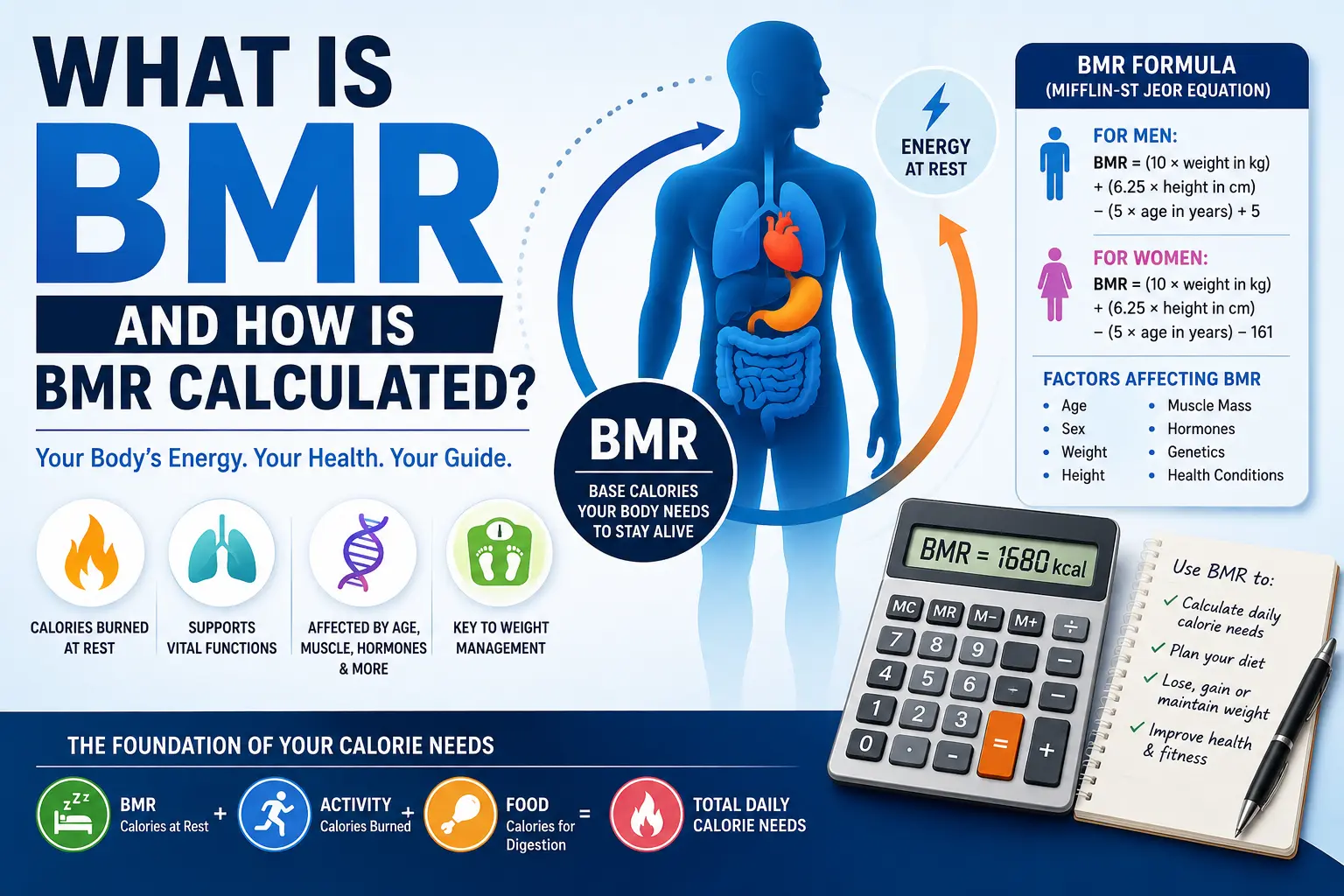
What Is BMR and How Is BMR Calculated? Complete Guide
What Is BMR and How Is BMR Calculated?
Understanding how your body uses energy is one of the most important steps toward managing your health, maintaining your weight, or planning a nutrition program. One of the key measurements used by nutritionists, fitness professionals, and healthcare providers is BMR.
If you’ve ever used a calorie tracker or searched for your daily calorie needs, you’ve likely come across the term BMR. But what exactly does it mean, and how is it calculated?
This guide explains everything you need to know about Basal Metabolic Rate, including the formulas used, factors that influence it, practical examples, and how it relates to weight loss and overall health.
What Is BMR?
BMR stands for Basal Metabolic Rate.
It represents the number of calories your body needs to perform essential life-sustaining functions while at complete rest.
These functions include:
- Breathing
- Blood circulation
- Maintaining body temperature
- Cell production and repair
- Hormone regulation
- Brain and nervous system activity
Even if you stayed in bed all day and did absolutely nothing, your body would still burn calories to keep you alive. Those calories make up your BMR.
BMR Meaning in Simple Terms
Think of BMR as your body’s minimum energy requirement.
It is the baseline number of calories needed before adding any physical activity, exercise, or daily movement.
For example, if your BMR is 1,600 calories per day, your body needs approximately 1,600 calories simply to maintain basic functions.
You can estimate your BMR using Calcylab’s BMR Calculator:
Why Is BMR Important?
Knowing your BMR provides valuable insight into your body’s energy requirements.
It helps with:
Weight Management
Understanding your BMR helps determine how many calories you should eat to lose, gain, or maintain weight. If you’re wondering how many calories your BMR burns per day, read our detailed guide to understand how resting calorie burn contributes to your total daily energy needs.
Meal Planning
Nutrition plans are often built around calorie requirements, which begin with BMR calculations.
Fitness Goals
Athletes and fitness enthusiasts use BMR to estimate energy needs and optimize performance.
Understanding Metabolism
BMR gives a clearer picture of how efficiently your body uses energy.
You can further estimate your total daily energy requirements using Calcylab’s Calorie Calculator:
Factors That Affect BMR
Several biological and lifestyle factors influence your Basal Metabolic Rate.
| Factor | Effect on BMR |
|---|---|
| Age | BMR generally decreases with age |
| Sex | Men often have higher BMR due to greater muscle mass |
| Weight | Larger bodies require more energy |
| Height | Taller individuals typically have higher BMR |
| Muscle Mass | More muscle increases calorie burn |
| Genetics | Natural metabolic differences exist |
| Hormones | Thyroid hormones significantly affect metabolism |
| Health Conditions | Certain conditions may increase or decrease BMR |
Age and BMR
As people age, muscle mass tends to decline, causing BMR to decrease. If you want to compare your result with normal BMR values by age and gender, see our detailed reference guide to understand what is considered typical for different age groups and men and women.
If you need to calculate your exact age for health assessments, try Calcylab’s:
Muscle Mass and BMR
Muscle tissue burns more calories than fat tissue, even at rest.
This is one reason strength training can help increase metabolic rate over time.
How Is BMR Calculated?
BMR is estimated using mathematical formulas developed through scientific research.
The most commonly used formula today is the Mifflin-St Jeor Equation because it provides accurate estimates for most adults.
The calculation uses:
- Weight
- Height
- Age
- Biological sex
These variables help estimate the calories required for basic bodily functions.
BMR Formula Explained
Mifflin-St Jeor Formula for Men
BMR = (10 × weight in kg) + (6.25 × height in cm) − (5 × age in years) + 5
Mifflin-St Jeor Formula for Women
BMR = (10 × weight in kg) + (6.25 × height in cm) − (5 × age in years) − 161
Alternative Formula: Harris-Benedict Equation
The Harris-Benedict Equation is another commonly referenced formula, although many experts now prefer Mifflin-St Jeor due to improved accuracy.
| Formula | Common Use |
|---|---|
| Mifflin-St Jeor | Modern standard |
| Harris-Benedict | Traditional method |
| Katch-McArdle | Uses lean body mass |
For quick and accurate calculations, use the Calcylab:
BMR Calculation Examples
Let’s look at practical examples.
Example 1: Male
Age: 30 years
Weight: 80 kg
Height: 180 cm
Calculation:
BMR = (10 × 80) + (6.25 × 180) − (5 × 30) + 5
BMR = 800 + 1125 − 150 + 5
BMR = 1,780 calories/day
Example 2: Female
Age: 28 years
Weight: 65 kg
Height: 165 cm
Calculation:
BMR = (10 × 65) + (6.25 × 165) − (5 × 28) − 161
BMR = 650 + 1031.25 − 140 − 161
BMR = 1,380 calories/day (approximately)
What Happens Next?
After calculating BMR, an activity multiplier is applied to estimate total daily calorie expenditure (TDEE).
This determines actual daily calorie needs.
You can calculate that using:
BMR vs BMI
Many people confuse BMR with BMI, but they measure completely different things. If you’re unsure which measurement is more important for your health or weight-loss goals, read our detailed guide on BMR vs BMI: What’s the Difference and Which One Matters More? before comparing the two.
| BMR | BMI |
|---|---|
| Measures calories burned at rest | Measures weight relative to height |
| Indicates energy requirements | Indicates weight category |
| Used for nutrition planning | Used for health screening |
| Expressed in calories/day | Expressed as a numerical index |
Example
A person may have:
- Healthy BMI
- High BMR
Or:
- Overweight BMI
- Low BMR
These measurements serve different purposes.
To check your body mass index, use Calcylab’s:
BMR and Weight Loss
Understanding your BMR is one of the foundations of effective weight loss.
Why It Matters
Your body burns calories through:
- Basal metabolism (BMR)
- Physical activity
- Digestion of food
BMR usually accounts for 60% to 75% of total daily calorie expenditure.
Creating a Calorie Deficit
Weight loss occurs when you consistently consume fewer calories than your body uses.
Example:
- Daily calorie needs: 2,200 calories
- Daily intake: 1,800 calories
Deficit: 400 calories
Over time, this may contribute to weight loss.
However, consuming calories far below your BMR is generally not recommended without medical supervision because it may lead to:
- Muscle loss
- Fatigue
- Nutrient deficiencies
- Reduced metabolic efficiency
How to Increase Your BMR Naturally
Although genetics play a role, there are evidence-based ways to support a higher metabolic rate.
Build Muscle Mass
Resistance training helps increase lean muscle tissue, which burns more calories at rest.
Stay Physically Active
Regular movement contributes to overall calorie expenditure and helps preserve muscle.
Get Enough Protein
Protein requires more energy to digest compared to fats and carbohydrates.
Prioritize Sleep
Poor sleep can negatively affect hormones that regulate metabolism.
Avoid Extreme Dieting
Very low-calorie diets may reduce metabolic rate over time.
Manage Stress
Chronic stress may affect hormone balance and influence metabolism.
Common BMR Myths
Myth 1: A Fast Metabolism Is the Only Reason People Stay Thin
Body weight is influenced by many factors, including diet, activity level, genetics, and lifestyle.
Myth 2: BMR Never Changes
BMR can change due to age, muscle mass, weight changes, and health conditions.
Myth 3: Eating Frequently Dramatically Boosts Metabolism
Meal frequency has a relatively small effect compared to total calorie intake and physical activity.
Myth 4: Everyone With the Same Weight Has the Same BMR
Factors such as age, height, muscle mass, and sex create significant differences.
Myth 5: BMR Equals Daily Calorie Needs
BMR only represents calories burned at rest. Actual calorie needs are higher because they include activity and digestion.
What does BMR mean?
BMR stands for Basal Metabolic Rate, the number of calories your body burns at complete rest.
How do I calculate my BMR?
You can use formulas such as the Mifflin-St Jeor Equation or an online BMR calculator.
Is BMR the same as metabolism?
BMR is a major component of metabolism but does not represent all calories burned throughout the day.
What is a healthy BMR?
There is no single healthy BMR value. It varies based on age, sex, height, weight, and body composition.
Does age affect BMR?
Yes. BMR generally decreases with age due to reductions in muscle mass and metabolic activity.
Can exercise increase BMR?
Strength training can increase muscle mass, which may help raise BMR over time.
What is the best BMR formula?
The Mifflin-St Jeor Equation is widely considered one of the most accurate formulas for most adults.
How is BMR different from BMI?
BMR measures calorie needs, while BMI measures body weight relative to height.
Should I eat below my BMR to lose weight?
Consistently eating below BMR may not be appropriate and can affect health and metabolism. Consult a healthcare professional for personalized advice.
What calculator should I use after finding my BMR?
A calorie calculator can help estimate your total daily energy needs based on activity level.
Related Calculators on Calcylab
While learning about BMR, you may also find these tools useful:
- BMR Calculator: https://calcylab.com/bmr-calculator/
- BMI Calculator: https://calcylab.com/bmi-calculator/
- Calorie Calculator: https://calcylab.com/calorie-calculator/
- Age Calculator: https://calcylab.com/age-calculator/
- Health Calculators: https://calcylab.com/health-calculators/
- Percentage Calculator: https://calcylab.com/percentage-calculator/
- Average Calculator: https://calcylab.com/average-calculator/
- All Calculators: https://calcylab.com/all-calculators/
- Blog: https://calcylab.com/blog/
Final Thoughts
Understanding what BMR is and how BMR is calculated can help you make more informed decisions about nutrition, fitness, and weight management.
Basal Metabolic Rate represents the energy your body needs to maintain essential functions at rest. By calculating your BMR and combining it with your activity level, you can better estimate your daily calorie needs and create realistic health goals.
While BMR is an important metric, it should be viewed as one piece of a broader health picture that includes physical activity, body composition, diet quality, sleep, and overall lifestyle habits.