Fixed Deposit vs Mutual Fund: Which Is Better in 2026?
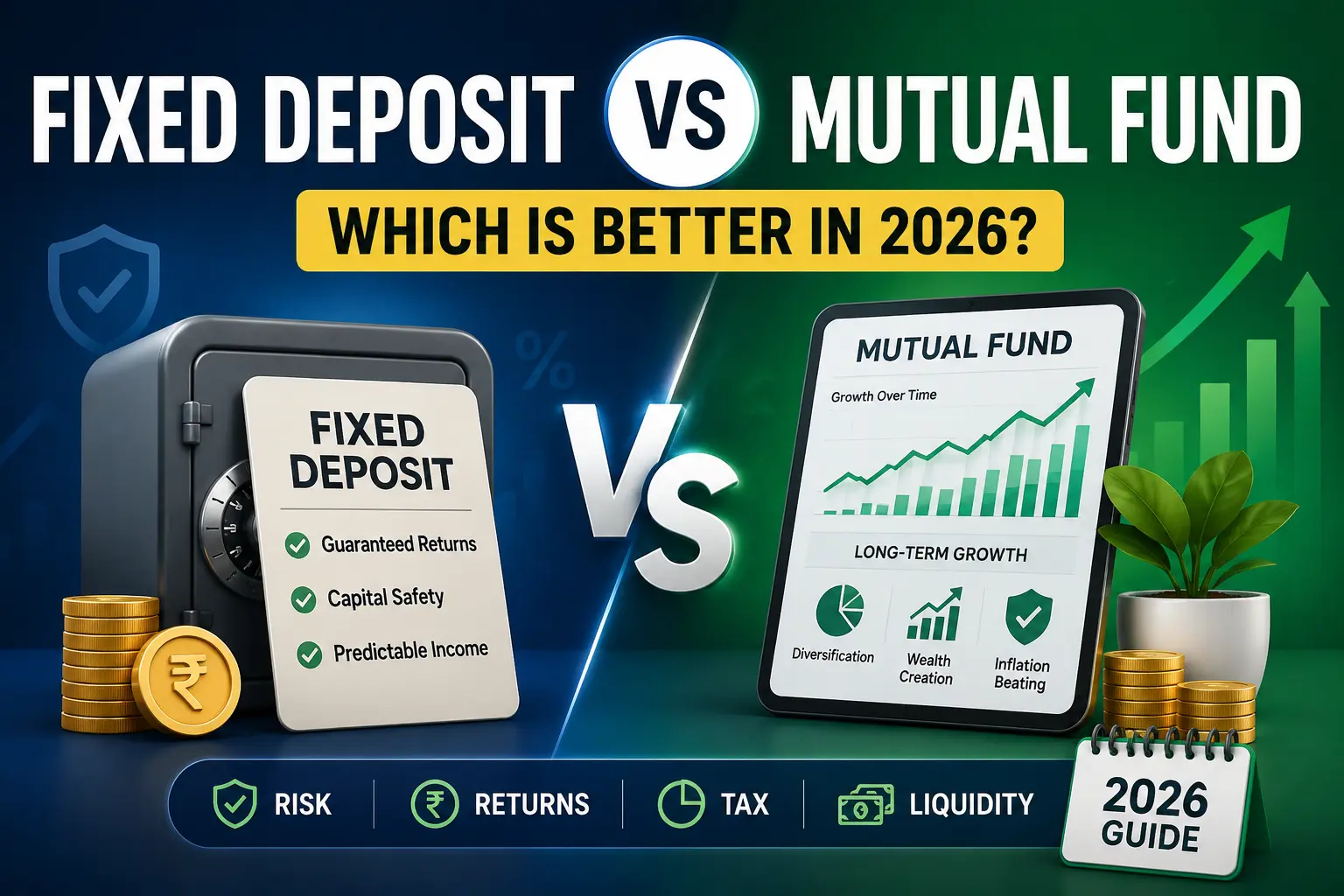
If you are trying to decide between a fixed deposit vs mutual fund in 2026, the honest answer is: it depends on what you need the money to do. A Fixed Deposit gives you guaranteed, predictable returns and full capital protection. A Mutual Fund gives you the potential for higher, inflation-beating growth, but with market-linked risk. Neither is “better” in isolation — the right choice depends on your goal, your time horizon, your risk appetite, and your tax situation. This guide breaks down FD vs Mutual Fund across returns, risk, tax, liquidity, and inflation, with real Indian investment scenarios, so you can decide exactly where your money should go.
What Is a Fixed Deposit?
A Fixed Deposit (FD) is a savings instrument offered by banks and NBFCs, regulated by the Reserve Bank of India (RBI). You deposit a lump sum for a fixed tenure — anywhere from 7 days to 10 years — and the bank pays you a pre-agreed, guaranteed interest rate. You can use a FD calculator with compound interest to see exactly how much your deposit will grow before you invest.
- Guaranteed returns: The interest rate is fixed at the time of booking and does not change with market movements.
- Safety: Bank FDs are insured up to ₹5 lakh per depositor per bank under the DICGC scheme.
- Typical tenure: 7 days to 10 years, with most investors choosing 1–5 year tenures.
- Liquidity: FDs can be broken prematurely, usually with a penalty of 0.5%–1% on the interest rate.
To understand the mechanics in more detail, see our full guide on what a Fixed Deposit is and how it works, or use the FD Calculator to project your maturity amount.
What Is a Mutual Fund?
A Mutual Fund pools money from many investors and invests it in a diversified basket of stocks, bonds, or a mix of both, managed by a professional fund manager and regulated by SEBI. Returns are not guaranteed — they move with the market — but historically, equity mutual funds have outperformed FDs over long horizons.
- Equity Mutual Funds: Invest primarily in stocks. Higher risk, higher long-term growth potential.
- Debt Mutual Funds: Invest in bonds and fixed-income instruments. Lower risk than equity, generally more stable than equity but still market-linked.
- Hybrid Mutual Funds: A mix of equity and debt, designed to balance growth and stability.
- SIP (Systematic Investment Plan): Investing a fixed amount every month, which averages out market volatility over time. Use the SIP Calculator to estimate your future corpus.
- Lump Sum: Investing the full amount at once. Use the Lumpsum Calculator to project returns.
Fixed Deposit vs Mutual Fund: Complete Comparison
| Parameter | Fixed Deposit | Mutual Fund |
|---|---|---|
| Returns | Fixed, typically 6%–7.5% p.a. | Market-linked, 8%–14%+ p.a. (long term, not guaranteed) |
| Risk | Very low | Low to high, depending on fund type |
| Safety | DICGC insured up to ₹5 lakh | Not insured; subject to market and credit risk |
| Liquidity | Moderate; premature withdrawal penalty applies | High for most open-ended funds; T+1 to T+3 settlement |
| Taxation | Interest fully taxable as per income slab | Capital gains taxed; more tax-efficient for long-term equity holding |
| Inflation Protection | Weak; real returns often near zero after tax and inflation | Stronger over long term, especially equity funds |
| Investment Horizon | Short to medium term | Medium to long term (ideally 5+ years for equity) |
| Capital Protection | Full principal protection | No principal protection; value can fall |
| Wealth Creation | Limited; steady but modest growth | Strong potential over long horizons |
| Volatility | None | Low (debt) to high (equity) |
| Best For | Capital safety, short-term goals, predictable income | Long-term wealth creation, beating inflation |
| Ideal Investor | Conservative, retirees, short-term planners | Long-term investors comfortable with market fluctuations |
| Lock-in | Fixed tenure, but breakable with penalty | No lock-in (except ELSS: 3 years) |
| Premature Withdrawal | Allowed with interest penalty | Allowed; exit load may apply for a limited period |
Returns Comparison (2026)
Quick answer: Bank FDs in 2026 typically pay 6%–7.5% per year. Before investing, compare the latest offers in our Best Fixed Deposit Interest Rates India 2026 guide. Debt mutual funds have historically delivered 6%–8%, hybrid funds 8%–11%, and equity mutual funds 10%–14% over long periods — though equity returns fluctuate significantly year to year and are never guaranteed.
| Investment Type | Typical Annual Return Range | Return Type |
|---|---|---|
| Average Bank FD | 6.0% – 7.5% | Fixed, guaranteed |
| Corporate FD | 7.5% – 9.0% | Fixed, higher credit risk |
| Debt Mutual Fund | 6.0% – 8.0% | Market-linked, low volatility |
| Hybrid Mutual Fund | 8.0% – 11.0% | Market-linked, moderate volatility |
| Equity Mutual Fund | 10.0% – 14.0%+ (long term average) | Market-linked, high volatility |
These are historical ranges, not promises. Equity mutual fund returns in any single year can be negative. Never treat past performance as a guarantee of future results.
Risk Comparison
| Risk Type | Fixed Deposit | Mutual Fund |
|---|---|---|
| Credit Risk | Low (bank FDs); moderate (corporate FDs) | Present in debt funds if issuer defaults |
| Market Risk | None | High in equity, low-moderate in debt |
| Interest Rate Risk | None once booked; reinvestment risk at maturity | Debt fund NAVs move inversely with interest rates |
| Inflation Risk | High — fixed returns may not beat inflation | Lower over long term, especially in equity |
| Reinvestment Risk | High if rates fall at maturity | Low; SIPs continue regardless of rate cycles |
Tax Comparison
Fixed Deposit taxation: Interest earned on an FD is fully taxable as per your income tax slab, added to your total income under “Income from Other Sources.” Banks deduct TDS at 10% if interest exceeds ₹40,000 (₹50,000 for senior citizens) in a financial year. There is no indexation benefit and no long-term concession — every rupee of interest is taxed the same way, regardless of tenure.
Mutual Fund taxation: Mutual funds are taxed based on capital gains, not fixed interest, which makes them structurally more tax-efficient for long-term holdings.
| Fund Type | Short-Term (before threshold) | Long-Term (after threshold) |
|---|---|---|
| Equity Mutual Fund | Held under 12 months: taxed at 20% | Held over 12 months: taxed at 12.5% above ₹1.25 lakh gains/year |
| Debt Mutual Fund | Taxed as per income slab (all holding periods, post-2023 rules) | Same as short-term; no separate LTCG benefit currently |
Because FD interest is taxed every year regardless of whether you withdraw it, while mutual fund gains are taxed only on redemption, mutual funds — particularly equity funds held long term — tend to be more tax-efficient for wealth accumulation.
To understand TDS rules, tax slabs, exemptions, and how FD interest is taxed in detail, read our FD Tax Explained guide.
Inflation Comparison
Inflation is the silent factor most FD-only investors ignore. If your FD pays 7% and inflation runs at 6%, your real, inflation-adjusted return is close to 1% — and after tax, it can turn negative. Mutual funds, particularly equity funds, have historically outpaced inflation by a wider margin over 7–10+ year periods, because businesses grow revenue and profits alongside (and often faster than) inflation.
Example: ₹5,00,000 invested for 10 years at a 7% FD rate (taxed at 20% slab) grows to roughly ₹8.6 lakh nominal, but after adjusting for 6% average inflation, the real value is only marginally higher than what you started with. The same ₹5,00,000 in an equity mutual fund averaging 12% for 10 years could grow to approximately ₹15.5 lakh, comfortably outpacing inflation even after tax on redemption.
Liquidity Comparison
- FD premature withdrawal: Allowed, but banks typically reduce the applicable interest rate by 0.5%–1%, and some FDs (like tax-saver FDs) have a mandatory 5-year lock-in with no premature exit.
- Mutual fund redemption: Open-ended funds can be redeemed anytime; money is usually credited within 1–3 working days (T+1 for debt, T+2/T+3 for equity).
- Exit load: Many equity funds charge a 1% exit load if redeemed within 12 months; most debt funds have no or minimal exit load after a short period.
- Settlement time: FD premature closure is usually same-day or next-day; mutual fund redemption takes 1–3 business days to reflect in your bank account.
₹5 Lakh vs ₹10 Lakh: FD vs Mutual Fund Growth Over Time
Numbers make the FD vs mutual fund decision much clearer than percentages alone. Below is how a one-time investment of ₹5,00,000 and ₹10,00,000 could grow in an FD (at an assumed 7% p.a.) versus an equity mutual fund (at an assumed 12% p.a. long-term average), before accounting for tax. These are illustrative projections, not guarantees — use the Compound Interest Calculator to model your own numbers.
₹5,00,000 Lump Sum Investment
| Duration | FD @ 7% (approx.) | Equity Mutual Fund @ 12% (approx.) | Approx. Difference |
|---|---|---|---|
| 5 Years | ₹7,01,000 | ₹8,81,000 | ₹1,80,000 |
| 10 Years | ₹9,83,000 | ₹15,53,000 | ₹5,70,000 |
| 20 Years | ₹19,35,000 | ₹48,23,000 | ₹28,88,000 |
₹10,00,000 Lump Sum Investment
| Duration | FD @ 7% (approx.) | Equity Mutual Fund @ 12% (approx.) | Approx. Difference |
|---|---|---|---|
| 5 Years | ₹14,03,000 | ₹17,62,000 | ₹3,59,000 |
| 10 Years | ₹19,67,000 | ₹31,06,000 | ₹11,39,000 |
| 20 Years | ₹38,70,000 | ₹96,46,000 | ₹57,76,000 |
Notice how the gap widens dramatically after year 10 — this is compounding at work. The longer the horizon, the more the growth-oriented option pulls ahead, which is exactly why time horizon should drive your FD vs mutual fund decision more than short-term return chasing.
Monthly SIP vs Lump Sum FD: A Practical Example
Many investors don’t have a lump sum sitting idle — they invest in smaller, regular amounts. Here’s how a monthly investment compares to putting the same total amount into a recurring FD.
| Monthly Investment | Duration | Recurring FD @ 7% (approx.) | SIP in Equity MF @ 12% (approx.) |
|---|---|---|---|
| ₹10,000/month | 10 Years | ₹17,30,000 | ₹23,23,000 |
| ₹15,000/month | 10 Years | ₹25,95,000 | ₹34,85,000 |
| ₹10,000/month | 20 Years | ₹52,40,000 | ₹99,91,000 |
Use the SIP Calculator to run this projection with your own monthly amount, expected return, and duration.
Decision Tree: Which Should You Choose?
- If you want safety and guaranteed capital protection → choose a Fixed Deposit.
- If you want growth and can accept market ups and downs → choose a Mutual Fund (equity or hybrid, based on horizon).
- If your goal is less than 2 years away → choose a Fixed Deposit or a liquid/debt fund.
- If your goal is more than 7 years away → choose an equity or hybrid Mutual Fund via SIP.
- If you want both safety and growth → split your money: FD for the portion you cannot risk, Mutual Funds for the portion you can afford to grow over time.
- If you are building an emergency fund → choose a Fixed Deposit or a liquid mutual fund, never equity.
Real-Life Investment Scenarios
Scenario 1: 25-Year-Old Salaried Employee
Priya, 25, earns ₹8 lakh a year and has no dependents. With a 30+ year investment horizon and the ability to absorb short-term losses, she is in the best possible position to prioritize growth. If she invests ₹10,000/month in an equity mutual fund SIP for 30 years at an average 12% return, her corpus could grow to well over ₹3.5 crore, compared to under ₹1.2 crore if the same amount went into a recurring FD at 7%. Recommended approach: 80% equity mutual funds, 20% FD/debt reserved for a 3–6 month emergency fund.
Scenario 2: 35-Year-Old Family Man
Rakesh, 35, has two young children and a home loan. He has medium-term goals (children’s education in 12–15 years) alongside near-term obligations. A balanced mix works best: 50–60% in mutual funds (hybrid + equity) for his children’s education fund, 30–40% in FD for stability and loan-related contingencies, and a separate emergency fund in FD or liquid funds untouched by either goal.
Scenario 3: 50-Year-Old Investor
Sunita, 50, is 10 years from retirement and wants to protect what she has built while still growing it. A shift toward 40% equity mutual funds, 40% debt mutual funds/FD, and 20% FD for near-term needs helps balance growth with reduced volatility as retirement approaches.
Scenario 4: Senior Citizen
Mr. Verma, 65, is retired and depends on his investments for monthly income. Capital safety and predictable cash flow matter far more than growth at this stage. FDs — especially senior citizen FD schemes that typically offer 0.25%–0.75% higher rates than standard FDs — along with debt mutual funds, should dominate the portfolio, with only a small equity allocation (10–20%) retained for inflation protection over what could still be a 20+ year retirement.
Scenario 5: Retirement Planning (Long-Term Goal, 15–25 Years Away)
Anjali, 40, wants to build a retirement corpus over the next 20 years. With a long horizon, equity mutual funds via SIP should form the core of her retirement savings — an SIP of ₹20,000/month for 20 years at 12% could grow to approximately ₹2 crore. As she approaches her target retirement date, the strategy should gradually shift a growing share into debt funds and FDs to protect the accumulated corpus from a market downturn right before she needs the money — a strategy known as the “glide path.”
Retirement Corpus Comparison: FD-Only vs Mixed Portfolio
Assuming a monthly investment of ₹15,000 over a 25-year working career, here is how an FD-only approach compares to a mutual-fund-led approach.
| Approach | Assumed Return | Approx. Corpus After 25 Years |
|---|---|---|
| FD-only (Recurring Deposit style) | 7% p.a. | ₹1,21,00,000 |
| Mutual Fund SIP (Equity-heavy) | 12% p.a. | ₹2,83,00,000 |
| Balanced (50% FD / 50% MF) | Blended ~9.5% p.a. | ₹1,79,00,000 |
The FD-only approach feels safer day to day, but over a 25-year career, the gap in retirement readiness is substantial. This is the core argument for including mutual funds in a long-term retirement plan rather than relying on FDs alone.
When Fixed Deposit Is Better
- Emergency fund: You need guaranteed access to your principal without risk of loss.
- Capital protection: You cannot afford to lose even a portion of the invested amount.
- Short-term goals: Goals within 1–3 years (a wedding, a down payment) where market volatility could hurt you right before you need the money.
- Retirees: Predictable income with zero risk to principal.
- Low-risk investors: Anyone who would panic-sell during a market downturn is better off with an FD’s certainty.
When Mutual Fund Is Better
- Long-term wealth creation: Goals 7+ years away, where compounding and market growth have time to work.
- Inflation beating: When your priority is growing purchasing power, not just preserving capital.
- Retirement: Long horizons allow equity allocation to ride out short-term volatility.
- Children’s education: A 10–18 year horizon suits equity and hybrid mutual funds well.
- Young investors: Time is the biggest advantage — the earlier you start a SIP, the more compounding works in your favor.
Can You Invest in Both?
Yes — and for most Indian investors, a combination of FD and mutual funds, rather than an all-or-nothing choice, is the smarter strategy. FDs protect your near-term needs and emergency fund; mutual funds grow your long-term wealth. Use a Compound Interest Calculator to compare how each allocation grows over time.
| Age Group | Suggested FD Allocation | Suggested Mutual Fund Allocation |
|---|---|---|
| 20s | 10% – 20% | 80% – 90% |
| 30s | 20% – 30% | 70% – 80% |
| 40s | 30% – 40% | 60% – 70% |
| 50s | 40% – 50% | 50% – 60% |
| 60+ (Retirement) | 60% – 70% | 30% – 40% |
Common Mistakes Investors Make
- Keeping everything in FDs: This feels safe, but over decades it quietly loses to inflation — the money is “safe” in nominal terms but shrinks in real purchasing power.
- Ignoring inflation: Many investors focus only on the nominal FD rate advertised by the bank, without checking what remains after tax and inflation are subtracted.
- Choosing mutual funds without goals: Picking a fund because it’s “trending” on social media, rather than matching the fund type and risk level to a specific financial goal and time horizon.
- Expecting guaranteed mutual fund returns: Treating a fund’s past 5-year or 10-year average return as a promise, rather than a historical estimate that can vary significantly in any given year.
- Breaking FDs frequently: Repeated premature withdrawals erode returns through interest penalties and defeat the purpose of locking in a fixed rate.
- Ignoring taxes: Not accounting for how FD interest is taxed annually at your slab rate while mutual fund capital gains are taxed only on redemption — a difference that meaningfully changes the real, after-tax comparison.
Expert Tips Before Investing
- Build your emergency fund first — keep 3 to 6 months of expenses in an FD or liquid fund before investing further, so a market dip never forces you to sell mutual funds at a loss to cover an emergency.
- Invest goal-by-goal — match each investment’s horizon and risk level to a specific financial goal, rather than mixing your emergency fund, education fund, and retirement fund into one undifferentiated pool.
- Review your portfolio annually — rebalance as your goals, age, income, and risk appetite change over time, rather than setting an allocation once and forgetting it for a decade.
- Diversify — don’t rely on a single FD, a single bank, or a single mutual fund category; spread risk across instruments and, where relevant, across issuers.
- Invest consistently — SIPs benefit from rupee-cost averaging, which smooths out the impact of market timing far better than trying to guess the “right” moment for a lump-sum investment.
- Know your risk profile — an honest assessment of how you’d actually react to a 15% portfolio drop prevents panic-selling during market swings, which is often what erodes real-world mutual fund returns more than the market itself.
Frequently Asked Questions
1. Which is better, FD or mutual fund, in 2026?
It depends on your goal. FDs are better for capital safety and short-term needs; mutual funds are better for long-term, inflation-beating wealth creation.
2. Is FD completely risk-free?
Bank FDs are very low risk and insured up to ₹5 lakh per depositor per bank under DICGC, but they are not entirely risk-free from inflation or bank-specific issues beyond the insured limit.
3. Can mutual funds give negative returns?
Yes. Equity and even some debt mutual funds can lose value in the short term, especially during market downturns.
4. Is SIP better than FD?
For long-term goals (7+ years), SIP in equity mutual funds has historically outperformed FDs. For short-term goals, FD is generally safer. See our detailed SIP vs FD comparison.
5. Are mutual fund returns guaranteed?
No. Mutual fund returns are market-linked and never guaranteed, unlike FD interest rates.
6. How is FD interest taxed in India?
FD interest is added to your total income and taxed as per your income tax slab, with TDS deducted if interest exceeds ₹40,000 (₹50,000 for senior citizens) in a year.
7. How are mutual funds taxed?
Equity mutual funds held over 12 months are taxed at 12.5% on gains above ₹1.25 lakh per year; short-term gains are taxed at 20%. Debt mutual funds are taxed as per your income slab regardless of holding period.
8. Which is more liquid, FD or mutual fund?
Open-ended mutual funds are generally more liquid, with redemption credited in 1–3 business days, compared to FDs which may involve a premature withdrawal penalty.
9. Can I lose my principal in a mutual fund?
Yes, mutual funds do not guarantee principal protection; the value of your investment can fall below what you invested, especially in equity funds over short periods.
10. What is the average FD interest rate in 2026?
Bank FD rates in 2026 typically range between 6% and 7.5% per annum, depending on the bank and tenure.
11. Is a mutual fund good for a 1-year goal?
Generally no. For goals within 1–2 years, an FD or a liquid/debt fund is safer than an equity mutual fund, which can be volatile in the short term.
12. Should retirees invest in mutual funds?
Retirees can hold a small allocation (10–20%) in debt or hybrid mutual funds for inflation protection, but the bulk of their portfolio should prioritize safety through FDs and debt instruments.
13. What is the safest investment in India?
Bank Fixed Deposits, especially those insured under DICGC up to ₹5 lakh, are among the safest investment options in India.
14. Do mutual funds beat inflation better than FDs?
Over long periods (7–10+ years), equity mutual funds have historically outpaced inflation more effectively than FDs, whose fixed returns often barely keep up with or lag behind inflation.
15. What is a good FD and mutual fund allocation for a beginner?
A common starting point is 20–30% in FD for safety and emergency needs, and 70–80% in mutual funds for long-term growth, adjusted based on age and risk appetite.
16. Can I withdraw a mutual fund anytime?
Most open-ended mutual funds allow withdrawal anytime, though an exit load may apply if redeemed within a specified period, often 12 months for equity funds.
17. Is corporate FD safer than bank FD?
No. Corporate FDs generally offer higher interest rates than bank FDs but carry higher credit risk, as they are not covered by DICGC insurance.
18. How much should I keep in an emergency fund — FD or mutual fund?
An emergency fund should be kept in an FD or a liquid mutual fund, prioritizing safety and quick access over returns.
19. Which is better for tax saving, FD or mutual fund?
ELSS mutual funds offer tax deduction under Section 80C with a 3-year lock-in, generally shorter than the 5-year lock-in on tax-saver FDs, and have historically delivered higher post-tax returns.
20. Should I choose FD or mutual fund for a 10-year goal?
For a 10-year goal, mutual funds — particularly equity or hybrid funds — are generally better suited than FDs, since the longer horizon allows market volatility to average out while capturing higher growth potential.
Still deciding where to invest? Calculate your guaranteed returns with our FD Calculator, estimate mutual fund growth using the SIP Calculator, learn the basics in What Is a Fixed Deposit, compare the Best Fixed Deposit Interest Rates India 2026, and understand taxation through our FD Tax Explained guide before making your investment decision.
This article is for educational purposes only and should not be considered financial or investment advice. Investment decisions should be made after considering your financial goals, risk tolerance, and, if necessary, consulting a qualified financial advisor.