How to Calculate PPF Maturity Amount (With Formula & Example) (2026)
If you have a PPF account, or you are planning to open one, there is a good chance you have wondered exactly how your yearly deposits turn into a large maturity amount after 15 years. The good news is that the calculation is not complicated once you understand the formula and the logic behind it.
In this guide, you will learn exactly how PPF interest is calculated, the maturity formula used by banks and post offices, and how to work out your own PPF maturity amount by hand, step by step. We will also walk through three real examples using ₹50,000, ₹1,00,000, and ₹1,50,000 yearly investments, so you can see precisely how the numbers add up.
What is PPF Maturity Amount?
The PPF maturity amount is the total sum you receive when your Public Provident Fund account completes its lock-in period, which is 15 years from the end of the financial year in which the account was opened.
This amount includes two parts:
- The total principal you deposited over the years
- The total interest earned on those deposits, compounded annually
Because PPF falls under the Exempt-Exempt-Exempt (EEE) tax category, the entire maturity amount, including the interest portion, is completely tax-free when you withdraw it. This is one of the biggest reasons PPF remains a preferred long-term savings option for salaried employees, self-employed professionals, and parents saving for their children’s future.
If you are new to the scheme and want to understand the basics first, our detailed guide on what PPF is and how it works covers eligibility, tax benefits, and withdrawal rules in depth.
How PPF Interest is Calculated
Before jumping into the maturity formula, it helps to understand how PPF interest actually works month to month, because this affects how much your account grows.
PPF interest is calculated every month, but it is based on the lowest balance in your account between the 5th day of the month and the last day of that month. However, this monthly interest is not credited to your account right away. It gets compounded and credited only once a year, on 31st March.
Here is the practical impact of this rule:
- If you deposit money on or before the 5th of a month, that deposit earns interest for that entire month.
- If you deposit money after the 5th, say on the 10th or 20th, you lose out on interest for that month, since the balance considered is the one recorded on the 5th.
This is why financial planners often suggest making your yearly PPF deposit as a lump sum before 5th April, right at the start of the financial year, so your money earns interest for the maximum number of days possible.
PPF Maturity Formula Explained
The PPF maturity amount is calculated using a standard compound interest formula that is slightly adjusted for annual deposits made at the start of each year. Since PPF pays annual compound interest and assumes deposits made early in the financial year earn a full year of interest, the accepted formula used by most calculators and financial institutions is:
M = P × [{(1 + r)^n – 1} / r] × (1 + r)
This formula might look intimidating at first, but once you break it down into its parts, it becomes much easier to follow.
Formula Variables
| Symbol | Meaning |
|---|---|
| M | Maturity amount at the end of the tenure |
| P | Annual investment amount (same amount deposited every year) |
| r | Annual PPF interest rate, expressed as a decimal (for example, 7.1% becomes 0.071) |
| n | Total number of years the money is invested (usually 15 for the standard PPF tenure) |
This formula assumes that you deposit the same amount every year, right at the start of the financial year, so that each deposit earns interest for the full year. In real life, your yearly deposit amounts might vary, or you might deposit at different times during the year, which is why using an online calculator often gives a more accurate result than a single formula applied by hand.
Manual Calculation Step-by-Step
While the formula above gives you the final maturity figure in one go, it is often more useful to understand how the balance grows year by year. This is especially helpful if your deposit amount changes from year to year, since the single formula only works cleanly when the yearly deposit stays the same.
Here is the step-by-step logic used for a year-by-year manual calculation:
- Start with your opening balance. In the first year, this is zero for a new account.
- Add your yearly deposit to the opening balance.
- Multiply the total by (1 + r) to apply one year’s interest on the combined amount.
- The result becomes your closing balance for that year, which is also your opening balance for the next year.
- Repeat this process for all 15 years to arrive at your final maturity amount.
In formula form, for each year:
Closing Balance = (Opening Balance + Yearly Deposit) × (1 + r)
This method is more time-consuming than using the direct formula, but it gives you a clear, transparent picture of how much interest is added each year, which is useful for tracking your account’s growth over time.
Example: ₹50,000 Yearly Investment
Let us apply this method to a real example. Suppose you deposit ₹50,000 every year into your PPF account, and the interest rate stays constant at 7.1% per annum for all 15 years.
Using the manual step-by-step method described above, here is how the balance grows:
| Year | Deposit (₹) | Closing Balance (₹) |
|---|---|---|
| 1 | 50,000 | 53,550 |
| 3 | 50,000 | 1,72,326 |
| 5 | 50,000 | 3,08,567 |
| 8 | 50,000 | 5,51,395 |
| 10 | 50,000 | 7,43,375 |
| 12 | 50,000 | 9,63,584 |
| 15 | 50,000 | 13,56,070 |
At the end of 15 years, your total investment would be ₹7,50,000 (₹50,000 × 15 years), and your PPF maturity amount would be approximately ₹13,56,070. That means you would earn around ₹6,06,070 as pure interest, completely tax-free.
This shows how a relatively modest yearly deposit can still grow into a meaningful sum over the long term, purely through the power of consistent compounding.
Example: ₹1,00,000 Yearly Investment
Now let us look at a more detailed example with ₹1,00,000 deposited every year, again assuming a constant interest rate of 7.1% per annum. This time, we will show the full year-by-year breakdown so you can see exactly how compounding builds up over 15 years.
| Year | Deposit (₹) | Interest Earned (₹) | Closing Balance (₹) |
|---|---|---|---|
| 1 | 1,00,000 | 7,100 | 1,07,100 |
| 2 | 1,00,000 | 14,704 | 2,21,804 |
| 3 | 1,00,000 | 22,848 | 3,44,652 |
| 4 | 1,00,000 | 31,570 | 4,76,222 |
| 5 | 1,00,000 | 40,912 | 6,17,134 |
| 6 | 1,00,000 | 50,917 | 7,68,051 |
| 7 | 1,00,000 | 61,631 | 9,29,682 |
| 8 | 1,00,000 | 73,108 | 11,02,790 |
| 9 | 1,00,000 | 85,398 | 12,88,188 |
| 10 | 1,00,000 | 98,561 | 14,86,749 |
| 11 | 1,00,000 | 1,12,660 | 16,99,409 |
| 12 | 1,00,000 | 1,27,758 | 19,27,167 |
| 13 | 1,00,000 | 1,43,928 | 21,71,095 |
| 14 | 1,00,000 | 1,61,248 | 24,32,343 |
| 15 | 1,00,000 | 1,79,796 | 27,12,139 |
Notice how the interest earned each year keeps increasing, even though the deposit amount stays the same. In Year 1, the interest is just ₹7,100, but by Year 15, it has grown to nearly ₹1,79,796. This is the compounding effect at work: interest is being earned not just on your deposits, but on the interest from all the previous years as well.
At the end of 15 years, the total investment is ₹15,00,000, and the final maturity amount comes to approximately ₹27,12,139, meaning you earn around ₹12,12,139 in tax-free interest.
Example: ₹1,50,000 Yearly Investment
Since ₹1,50,000 is the maximum amount you can deposit in a PPF account in a single financial year, this example represents the highest possible maturity value for someone using PPF alone, without any top-up from other instruments.
Using the same 7.1% annual interest rate and the same step-by-step compounding method:
| Year | Deposit (₹) | Closing Balance (₹) |
|---|---|---|
| 1 | 1,50,000 | 1,60,650 |
| 3 | 1,50,000 | 5,16,978 |
| 5 | 1,50,000 | 9,25,701 |
| 8 | 1,50,000 | 16,54,185 |
| 10 | 1,50,000 | 22,30,124 |
| 12 | 1,50,000 | 28,90,751 |
| 15 | 1,50,000 | 40,68,209 |
At the maximum contribution level, your total investment over 15 years would be ₹22,50,000, and your maturity amount would be approximately ₹40,68,209. This works out to roughly ₹18,18,209 earned purely as tax-free interest, which highlights why PPF is often described as one of the most efficient long-term, low-risk savings tools available in India.
Effect of Different Interest Rates
The PPF interest rate is reviewed by the Ministry of Finance every quarter, which means it does not stay fixed for the entire 15-year tenure. Even small changes in the rate can have a noticeable impact on your final maturity amount, especially over a long period like 15 years.
To illustrate this, here is how the maturity amount changes for a ₹1,00,000 yearly investment over 15 years at different hypothetical interest rates, assuming the rate stays constant throughout the tenure for comparison purposes:
| Interest Rate | Approximate Maturity Amount (₹1,00,000/year for 15 years) |
|---|---|
| 6.5% | ₹25,75,401 |
| 7.0% | ₹26,88,805 |
| 7.1% (current rate) | ₹27,12,139 |
| 7.5% | ₹28,07,724 |
| 8.0% | ₹29,32,428 |
As you can see, even a difference of half a percentage point can change your maturity amount by more than a lakh of rupees over 15 years. This is why staying invested through periods of both higher and lower rates tends to average out over the long run, and why PPF’s stability, rather than any single year’s rate, is its real strength.
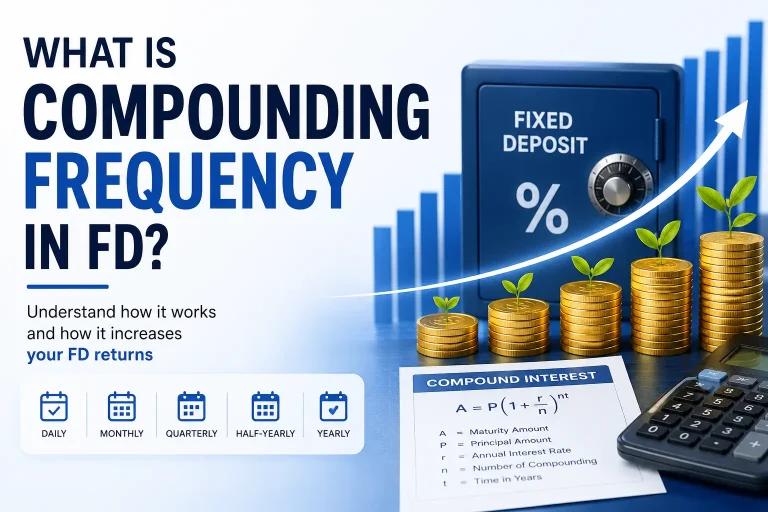
How Annual Compounding Works
Compounding is the core reason PPF grows the way it does, and understanding it clearly will help you make better decisions about how and when to deposit money.
In simple terms, compounding means you earn interest not only on your original deposits but also on the interest that has already been added to your account in previous years. Over a short period, this effect is barely noticeable. But over 15 years or more, it becomes the single biggest contributor to your final maturity amount.
Look back at the ₹1,00,000 yearly example above. In the first year, the interest earned was just ₹7,100. By the final year, the interest earned in that single year alone was ₹1,79,796, which is more than the entire yearly deposit itself. This happens because, by Year 15, the account is no longer earning interest on ₹1,00,000, but on a balance of over ₹25 lakh.
If you want to explore this effect further, using a Compound Interest Calculator can help you visualise how your money grows differently across various tenures, deposit amounts, and interest rates, beyond just PPF.
How PPF Calculator Saves Time
By now, you have seen that manually calculating PPF maturity, especially year by year, involves a fair amount of repetitive arithmetic. While it is useful to understand the process at least once, doing this manually every time you want to check your numbers is neither practical nor necessary.
An online PPF calculator removes this hassle entirely. Instead of computing each year’s balance by hand, you simply enter your yearly deposit amount, the current interest rate, and your investment tenure, and the calculator instantly shows you the projected maturity amount, along with a year-by-year breakdown if needed.
This becomes especially useful in a few common situations:
- When you want to compare how different yearly deposit amounts affect your final maturity value
- When you want to see the impact of extending your PPF account beyond 15 years in 5-year blocks
- When you are planning your overall retirement or savings strategy and need quick numbers without manual errors
- When interest rates change and you want to instantly recalculate your projections
You can try this yourself using our PPF Calculator, which is built specifically to handle these calculations accurately, based on the current PPF interest rate and standard compounding rules.
Common Mistakes While Calculating
Even when people understand the basic concept of PPF interest and compounding, a few common errors tend to creep in when they try to calculate maturity amounts by hand or estimate their returns.
- Assuming a fixed interest rate for all 15 years. The PPF rate is revised quarterly, so any manual projection using today’s rate is only an estimate, not a guarantee.
- Ignoring the deposit date within the month. Since interest depends on the balance between the 5th and the last day of the month, depositing late in the month can quietly reduce your yearly interest.
- Mixing up monthly and annual compounding. PPF interest is calculated monthly but compounded annually, which confuses many first-time investors who assume it works like a fixed deposit with monthly compounding.
- Forgetting to account for variable yearly deposits. The standard formula assumes the same deposit every year; if your contributions vary, a simple formula-based estimate will not match your actual account balance.
- Not considering the 5-year extension option. Some people calculate only up to 15 years and assume that is the maximum possible growth, without factoring in that the account can be extended in 5-year blocks with continued compounding.
- Rounding errors in manual, year-by-year calculations. Small rounding differences at each step can add up over 15 years, leading to a final figure that is slightly off from the actual bank or post office statement.
Expert tip: If you are depositing a lump sum every year, always try to complete the transaction before 5th April. This single habit, followed consistently over 15 years, can add a noticeable amount to your final maturity value simply because your money spends more days earning interest.
Expert tip: When comparing PPF with other fixed-income options, look at post-tax returns rather than just the headline interest rate. Since PPF interest is completely tax-free, its effective return can be higher than a fixed deposit even when the FD’s stated interest rate looks similar or slightly better. You can check this yourself using an FD Calculator to compare taxable FD returns against PPF’s tax-free growth for the same investment amount and tenure.
PPF Maturity Table
To give you a quick reference, here is a summary table showing approximate PPF maturity amounts after 15 years for different yearly investment amounts, based on the current interest rate of 7.1% per annum, compounded annually.
| Yearly Investment (₹) | Total Invested Over 15 Years (₹) | Approximate Maturity Amount (₹) | Approximate Interest Earned (₹) |
|---|---|---|---|
| 12,000 | 1,80,000 | 3,25,457 | 1,45,457 |
| 25,000 | 3,75,000 | 6,78,035 | 3,03,035 |
| 50,000 | 7,50,000 | 13,56,070 | 6,06,070 |
| 75,000 | 11,25,000 | 20,34,105 | 9,09,105 |
| 1,00,000 | 15,00,000 | 27,12,139 | 12,12,139 |
| 1,25,000 | 18,75,000 | 33,90,174 | 15,15,174 |
| 1,50,000 | 22,50,000 | 40,68,209 | 18,18,209 |
These figures assume the interest rate remains constant at 7.1% for all 15 years and that deposits are made at the start of each financial year. In practice, actual quarterly rate changes mean your real maturity amount may differ slightly from these projections, which is why it helps to recheck your numbers periodically as rates are updated.
Frequently Asked Questions
1. What is the formula to calculate PPF maturity amount? The standard formula is M = P × [{(1 + r)^n – 1} / r] × (1 + r), where M is the maturity amount, P is the yearly deposit, r is the annual interest rate as a decimal, and n is the number of years.
2. How much will ₹1,50,000 invested yearly in PPF grow to in 15 years? At the current interest rate of 7.1% per annum, depositing ₹1,50,000 every year for 15 years would grow to approximately ₹40,68,209, assuming the rate stays constant throughout the tenure.
3. Does PPF interest compound monthly or annually? PPF interest is calculated on a monthly basis, using the lowest balance between the 5th and the last day of the month, but it is compounded and credited to your account only once a year, at the end of the financial year.
4. Why does my actual PPF balance not exactly match the formula-based calculation? This usually happens because the interest rate changes every quarter, while the formula assumes a single fixed rate for all 15 years. Deposit timing, partial withdrawals, and loans against the account can also cause small differences.
5. Can I calculate PPF maturity if my yearly deposit amount changes every year? Yes, but the single formula only works cleanly for a fixed yearly deposit. If your contributions vary, you need to use the year-by-year manual method, or simply use an online PPF calculator that can handle variable deposits automatically.
6. What happens to my PPF maturity amount if I extend the account after 15 years? If you extend your PPF account in blocks of 5 years, either with or without further contributions, the existing balance continues to earn interest at the applicable rate, allowing your maturity amount to keep growing well beyond the initial 15-year period.
7. Is the PPF maturity amount taxable? No, the entire PPF maturity amount, including both the principal and the interest earned, is completely exempt from tax under the Exempt-Exempt-Exempt (EEE) structure.
8. How accurate is a PPF calculator compared to manual calculation? A PPF calculator is generally more accurate than a basic manual formula because it can account for the exact number of days deposits earn interest, changing interest rates, and variable yearly contributions, all of which are difficult to factor into a simple hand calculation.
9. Does depositing early in the financial year really make a big difference? Yes. Since interest is calculated on the balance present by the 5th of each month, depositing your yearly contribution before 5th April ensures your money earns interest for the maximum possible number of months in that financial year, which adds up meaningfully over 15 years.
10. What is the minimum and maximum yearly deposit used in PPF maturity calculations? PPF maturity calculations typically use a yearly deposit between the minimum limit of ₹500 and the maximum limit of ₹1,50,000, since these are the actual limits allowed under the scheme in a single financial year.
Conclusion
Calculating your PPF maturity amount by hand is a valuable exercise at least once, since it helps you truly understand how compounding builds wealth over time, rather than just seeing a final number. As you have seen through the ₹50,000, ₹1,00,000, and ₹1,50,000 examples, even modest yearly deposits can grow into a substantial, completely tax-free sum over 15 years, especially in the later years when compounding accelerates.
That said, since PPF interest rates change every quarter and real-life deposit patterns are rarely perfectly consistent, manual calculations will always be approximate. For accurate, up-to-date projections tailored to your own deposit amount and timeline, it is far more practical to rely on a dedicated calculator rather than repeating this arithmetic by hand every time.
If you are also planning your broader retirement strategy alongside PPF, it can help to compare guaranteed, fixed-income growth with market-linked options using an NPS Calculator, so you can build a savings plan that balances safety with growth potential.
Go ahead and calculate your own PPF maturity amount using the calculator above, based on your yearly deposit, tenure, and the current interest rate, and take the guesswork out of your long-term financial planning.