FD Monthly Payout vs Cumulative FD: Which Should You Choose?
If you are about to open a Fixed Deposit, your bank will ask you one important question: do you want your interest paid out every month, or do you want it added back to your deposit and paid in one lump sum at maturity? This single choice, called the FD payout option, changes how much money you earn, how much tax you pay each year, and how useful your FD is for your day-to-day life.
A Monthly Payout FD pays you interest every month, like a small salary from your savings. A Cumulative FD holds back that interest, reinvests it, and hands you a bigger lump sum when the deposit matures. Both are safe. Both use the same bank interest rate. But they serve two completely different financial goals.
This guide is for anyone comparing FD monthly payout vs cumulative FD before opening a deposit — retirees who need monthly income, salaried employees deciding where to park a bonus, and long-term savers building a goal-based corpus. By the end, you will know exactly which option fits your situation, backed by a real number example and a full comparison table.
What Is a Monthly Payout Fixed Deposit?
A Monthly Payout FD, also called a non-cumulative FD, pays out the interest you earn every month directly into your savings account. The principal amount stays locked in the FD until maturity, but the interest never gets added back to it. You simply receive a fixed monthly credit for as long as the FD runs.
Banks calculate this monthly interest using simple interest on the principal, not compound interest, because nothing is being reinvested. If you want to understand the base formula banks use, our guide on FD compound interest vs simple interest breaks this down clearly.
How It Works
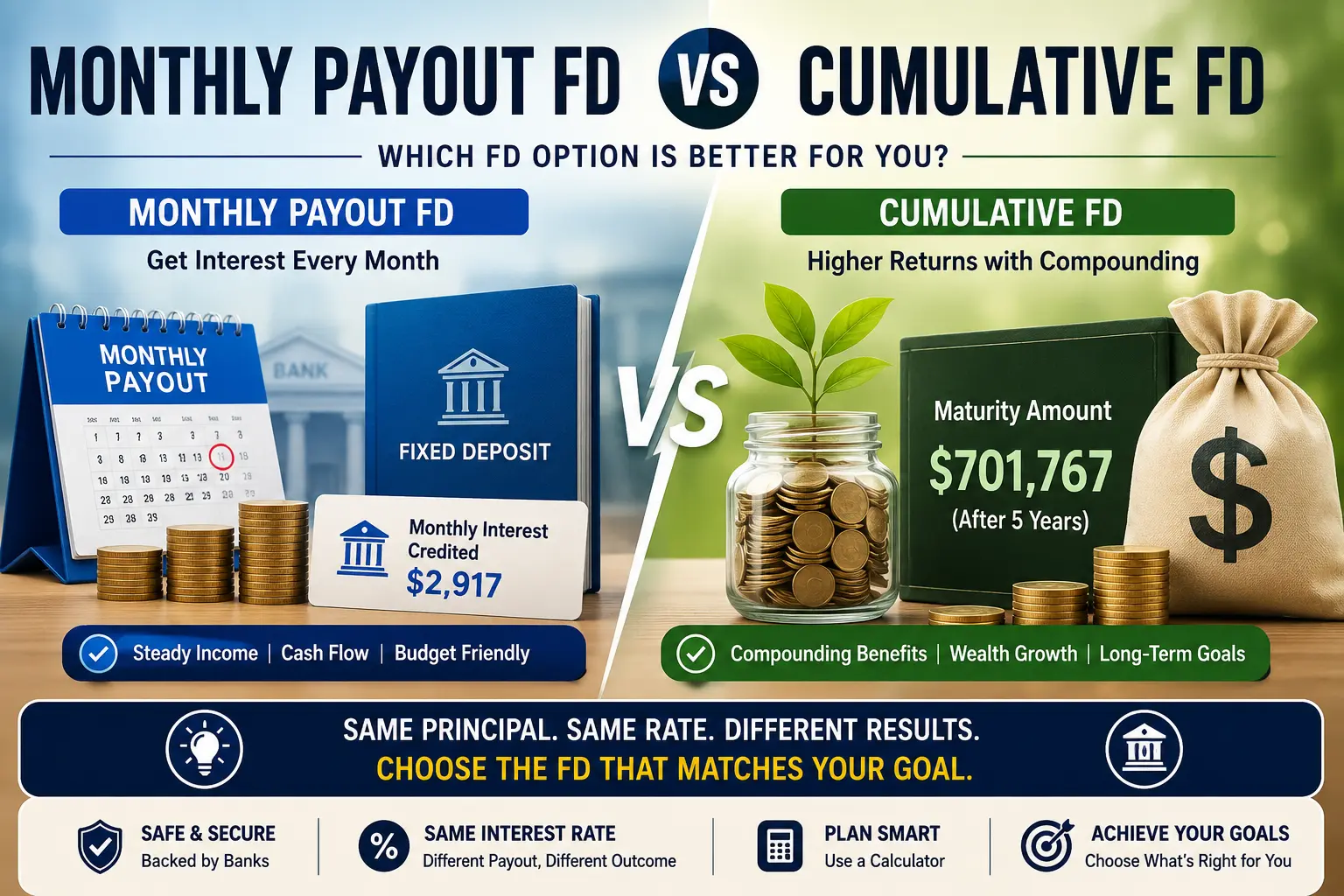
The bank multiplies your principal by the annual interest rate, then divides that figure by 12 to get your monthly payout. So a $500,000 deposit at 7% per year would generate roughly $2,917 every month, credited on a fixed date until the FD matures. Some banks apply a slightly lower rate on monthly payout FDs compared to cumulative FDs, since they are paying out interest before it has a chance to compound. Always check the exact rate card before opening the account.
Advantages of Monthly Payout FD
- Gives you a steady, predictable monthly income without touching your principal
- Works well for retirees who need cash flow to cover household expenses
- Helps you plan a monthly budget with a fixed, guaranteed number
- Useful for covering recurring costs like rent, EMIs, or utility bills
- You can reinvest the monthly payout elsewhere, such as a Systematic Investment Plan (SIP), if you don’t need it immediately
Disadvantages of Monthly Payout FD
- You lose the benefit of compounding, since interest is paid out instead of reinvested
- Total returns over the tenure are lower than a cumulative FD at the same rate
- Monthly income is taxable in the year you receive it, which can affect your annual tax planning
- Banks may offer a marginally lower interest rate for this option
What Is a Cumulative Fixed Deposit?
A Cumulative FD does the opposite. Instead of paying out interest monthly, the bank reinvests it back into your deposit. That reinvested interest then earns interest of its own in the following period. This is compounding, and it is the single biggest reason cumulative FDs grow faster than monthly payout FDs over time.
You don’t see any of this money until the FD matures. At that point, you receive one lump sum: your original principal plus every rupee of compounded interest. To see how this compares with a reinvestment structure specifically, read our detailed breakdown of cumulative FD vs reinvestment FD.
How It Works
Most banks compound cumulative FD interest quarterly. Each quarter, the accumulated interest gets added to the principal, and the next quarter’s interest is calculated on this new, larger amount. Over a 5-year tenure, this compounding effect can add a meaningful sum on top of what simple monthly payouts would ever generate. You can test this yourself with our FD Calculator or our dedicated compound interest calculator.
Learn how quarterly, monthly, and yearly compounding affect returns in What Is Compounding Frequency in FD?
Advantages of Cumulative FD
- Higher overall returns thanks to compounding
- Ideal for long-term goals like a child’s education, a house down payment, or a retirement corpus
- Simplifies tax filing since there is only one interest credit event, at maturity
- No temptation to spend the interest along the way, since it stays locked in
Disadvantages of Cumulative FD
- Zero liquidity during the tenure — you get nothing until maturity
- Not suitable if you need regular income to cover monthly expenses
- The entire interest amount becomes taxable in the year of maturity, which can push you into a higher TDS deduction that year
- Breaking the FD early to access funds usually comes with a penalty
Monthly Payout FD vs Cumulative FD: Full Comparison
| Factor | Monthly Payout FD | Cumulative FD |
|---|---|---|
| Purpose | Regular income | Wealth accumulation |
| Interest Payment | Paid out every month | Reinvested, paid only at maturity |
| Compounding | No compounding on paid-out interest | Interest compounds, usually quarterly |
| Monthly Income | Yes, fixed monthly credit | None during the tenure |
| Overall Returns | Lower than cumulative at the same rate | Higher, due to compounding |
| Liquidity | Principal locked, but interest is accessible monthly | Fully locked until maturity |
| Best For | Retirees, pensioners, anyone needing monthly cash flow | Long-term savers, goal-based investors |
| Risk | Low, same as any bank FD | Low, same as any bank FD |
| Tax Impact | Interest taxed each year it is received | Interest taxed in the year of maturity, in one lump sum |
| Growth Pattern | Flat, linear growth of income | Accelerating growth due to compounding |
| Maturity Amount | Principal only, interest already paid out | Principal plus all compounded interest |
| Suitable Investor | Income-focused, near or in retirement | Growth-focused, has other income sources |
Real Example: $500,000 at 7% for 5 Years
Numbers make this comparison much easier to understand. Let’s assume you deposit $500,000 at 7% per annum for a tenure of 5 years, and compare both payout options side by side. We’ve used the dollar symbol here to keep the example easy to follow for readers everywhere; simply swap in your own currency, since the calculation logic works the same way regardless of which currency you invest in. These figures are illustrative; your actual bank rate and compounding frequency may differ slightly, so always confirm with your bank or run the exact numbers through our FD calculator before investing.
Monthly Payout FD
| Detail | Amount |
|---|---|
| Principal Deposited | $500,000 |
| Approximate Monthly Interest Credit | $2,917 |
| Total Interest Over 5 Years (60 months) | $175,000 |
| Amount Returned at Maturity | $500,000 (principal only) |
| Total Value Received Overall | $675,000 |
Cumulative FD
| Detail | Amount |
|---|---|
| Principal Deposited | $500,000 |
| Monthly Income Received | $0 |
| Approximate Maturity Amount (quarterly compounding) | $707,450 |
| Total Interest Earned | $207,450 |
You can recreate this example with our FD Calculator.
The Difference
In this example, the Cumulative FD delivers roughly $32,450 more in total value than the Monthly Payout FD over the same 5-year period, purely because of compounding. In exchange, the Monthly Payout FD gives you approximately $2,917 every month that you can spend or reinvest right away, something the Cumulative FD does not offer at all until year five. Neither option is “wrong” — they are built for different needs.
Which Option Gives Better Returns?
At the same interest rate and tenure, a Cumulative FD will almost always give a higher total return than a Monthly Payout FD. This is simply how compounding works: interest that stays invested keeps earning more interest, while interest that is paid out stops growing the moment it leaves your deposit. The longer your tenure, the bigger this gap becomes. Our guide on What Is Compounding Frequency in FD? explains this snowball effect in more detail if you want to understand the mechanics behind it.
That said, “better returns” only matters if you don’t need the money along the way. A Monthly Payout FD isn’t giving up returns for no reason — it’s trading some growth for immediate, usable income.
Which Option Is Better for Retirees?
For most retirees, a Monthly Payout FD tends to be more practical. Retirement usually means your salary has stopped, and you need a dependable, fixed stream of income to cover groceries, medical costs, and household bills. A monthly payout turns your FD into something close to a pension. You know exactly what is landing in your account every month, and you never need to break the deposit early to access cash. Senior citizens can also compare current bank offers using our page on best fixed deposit interest rates in India, since many banks offer higher rates for senior citizen FDs.
Which Option Is Better for Salaried Employees?
If you’re salaried and already have a regular monthly income from your job, a Cumulative FD usually makes more sense. You don’t need the FD to replace income you already have — you need it to grow. Parking a bonus, an increment, or surplus savings into a cumulative FD lets compounding do the work quietly in the background while your salary covers your monthly expenses. If you’re also exploring other growth options, it’s worth comparing this route against equity-linked investing in our article on SIP vs FD returns.
Which Option Is Better for Long-Term Investors?
For long-term, goal-based investors — saving for a child’s education, a house down payment, or a retirement corpus 10 to 15 years away — the Cumulative FD is generally the stronger choice. The longer your money stays untouched and compounding, the larger the gap becomes between a cumulative FD and a monthly payout FD. If your goal is still years away and you don’t need the interest for living expenses, letting it compound is usually the more efficient path. You can also compare this against other long-term investments by reading our SIP vs FD comparison.
Tax on Monthly Payout vs Cumulative FD
FD interest is fully taxable as “Income from Other Sources” under Indian tax law, regardless of whether you choose monthly payout or cumulative. The difference is in when that tax liability shows up.
- With a Monthly Payout FD, interest is credited — and becomes taxable — every year you receive it. This can actually work in your favor, since the tax burden is spread out evenly across several years instead of arriving as one large amount.
- With a Cumulative FD, all the compounded interest is credited in the year of maturity. This means your entire multi-year interest gain lands in your taxable income for a single financial year, which can push you into a higher TDS deduction bracket that year even though you earned the interest gradually over time.
Banks deduct TDS on FD interest once it crosses the prescribed threshold in a financial year. If your total income is below the taxable limit, you can submit Form 15G (or Form 15H if you are a senior citizen) to avoid TDS deduction. This is general education, not tax advice — always confirm current TDS thresholds and your applicable tax slab with a qualified tax advisor or chartered accountant before making a decision based on tax impact alone.
Common Mistakes to Avoid
- Choosing monthly payout without an actual income need. If you don’t need the monthly cash, you’re giving up compounding for no real benefit.
- Ignoring inflation. A fixed monthly payout that looks generous today may lose real value over a 5 or 10-year tenure as prices rise.
- Ignoring the tax timing difference. A large cumulative maturity payout can unexpectedly increase your tax liability in that one year.
- Underestimating the power of compounding. Many investors don’t realize how much a cumulative FD can outperform a monthly payout FD over longer tenures.
- Choosing the wrong tenure for your goal. Locking money into a 5-year cumulative FD when you actually need it in 18 months creates unnecessary early-withdrawal penalties.
- Not comparing rates across banks. Payout structure matters, but so does the base interest rate — a small rate difference compounds significantly over several years.
Tips Before Opening an FD
- Be honest about whether you need monthly income or long-term growth before choosing a payout type
- Compare interest rates across banks, since monthly payout FDs sometimes carry a slightly lower rate than cumulative FDs
- Check the exact compounding frequency your bank uses for cumulative FDs — monthly, quarterly, and annual compounding all produce different maturity amounts
- Use an FD calculator to run your exact numbers before committing
- Keep an emergency fund outside your FD so you’re never forced to break it early and lose interest
- If you’re unsure, ask your bank whether you can split your deposit between both options rather than committing the full amount to just one
Frequently Asked Questions
Which FD gives higher returns, monthly payout or cumulative?
A Cumulative FD generally gives higher total returns at the same interest rate and tenure, because the interest compounds instead of being paid out and stopping its growth.
What is a cumulative FD?
A cumulative FD is a fixed deposit where the interest earned is reinvested into the principal instead of being paid out regularly. You receive the full amount, principal plus compounded interest, only at maturity.
What is a monthly payout FD?
A monthly payout FD pays the interest you earn directly into your bank account every month, while your original principal stays locked until the FD matures.
Is monthly payout FD interest taxable?
Yes. Interest from a monthly payout FD is taxable in the year you receive it, just like any other FD interest income.
Is cumulative FD interest taxed differently?
The interest itself is taxed the same way, but with a cumulative FD, the entire multi-year interest amount becomes taxable in the single financial year the FD matures, rather than being spread across each year.
Which FD is best after retirement?
A monthly payout FD is usually better after retirement, since it provides a predictable income stream to cover regular living expenses without needing to break the deposit.
Can I switch from cumulative to monthly payout after opening the FD?
Most banks do not allow you to change the payout option once the FD is opened. If you want a different structure, you typically need to close the existing FD and open a new one, which may involve a penalty.
What happens at maturity in a cumulative FD?
At maturity, you receive one lump sum that includes your original principal plus all the interest that compounded over the tenure.
What happens at maturity in a monthly payout FD?
At maturity, you receive only your original principal back, since all the interest was already paid out to you monthly throughout the tenure.
Does a monthly payout FD offer a lower interest rate than a cumulative FD?
Some banks offer a slightly lower rate on monthly payout FDs compared to cumulative FDs, since the bank pays out interest before it has a chance to compound. Always check the specific rate card at your bank.
Is cumulative FD better for long-term goals?
Yes. For goals that are several years away, such as a child’s education or a retirement corpus, a cumulative FD’s compounding effect typically produces a larger final amount than a monthly payout FD.
Can I use FD interest as regular income instead of a salary?
Yes, this is exactly what a monthly payout FD is designed for. It works especially well for retirees or anyone who needs steady income without a regular job.
Does the compounding frequency affect my cumulative FD returns?
Yes. Monthly compounding produces a slightly higher maturity amount than quarterly compounding, which in turn produces a higher amount than annual compounding, even at the same stated interest rate.
What is TDS on FD interest?
TDS, or Tax Deducted at Source, is the tax your bank deducts on FD interest once it crosses a prescribed threshold in a financial year. The exact threshold and rate can change, so confirm the current figures with your bank or a tax advisor.
How can I avoid TDS on FD interest if my income is low?
If your total income falls below the taxable limit, you can submit Form 15G, or Form 15H if you are a senior citizen, to your bank to request that TDS not be deducted.
Is a quarterly payout FD different from a monthly payout FD?
Yes. A quarterly payout FD pays interest every three months instead of every month. It usually results in a marginally higher total payout than monthly options, but still less than a fully cumulative FD, since it also lacks full compounding.
Can I split my deposit between monthly payout and cumulative FD?
Many banks allow you to open separate FDs with different payout structures. This lets you keep part of your money generating monthly income while the rest compounds for long-term growth.
How do I calculate my exact FD maturity amount?
The easiest way is to use an FD calculator, where you enter your principal, interest rate, tenure, and payout type to instantly see your expected returns.
Is FD interest safer than mutual fund returns?
FD returns are fixed and guaranteed by the bank, regardless of market conditions, while mutual fund returns fluctuate with the market. FDs are generally considered lower risk but typically offer lower long-term growth potential compared to equity-linked instruments. Read our comparison on SIP vs FD for a deeper look.
Which is easier to manage for tax filing, monthly payout or cumulative FD?
A cumulative FD is often simpler to track for tax filing since there is just one interest credit event at maturity, compared to twelve smaller credits per year with a monthly payout FD.
There is no single “better” FD payout option. A monthly payout FD is the right tool when you need income now. A cumulative FD is the right tool when you need growth later. The smartest move is matching the payout structure to your actual financial goal, not just picking whichever number looks bigger on paper.
Ready to run your own numbers? Try our FD Calculator to compare monthly payout and cumulative maturity amounts instantly, or explore our full range of finance calculators and all calculators to plan your next financial move.
