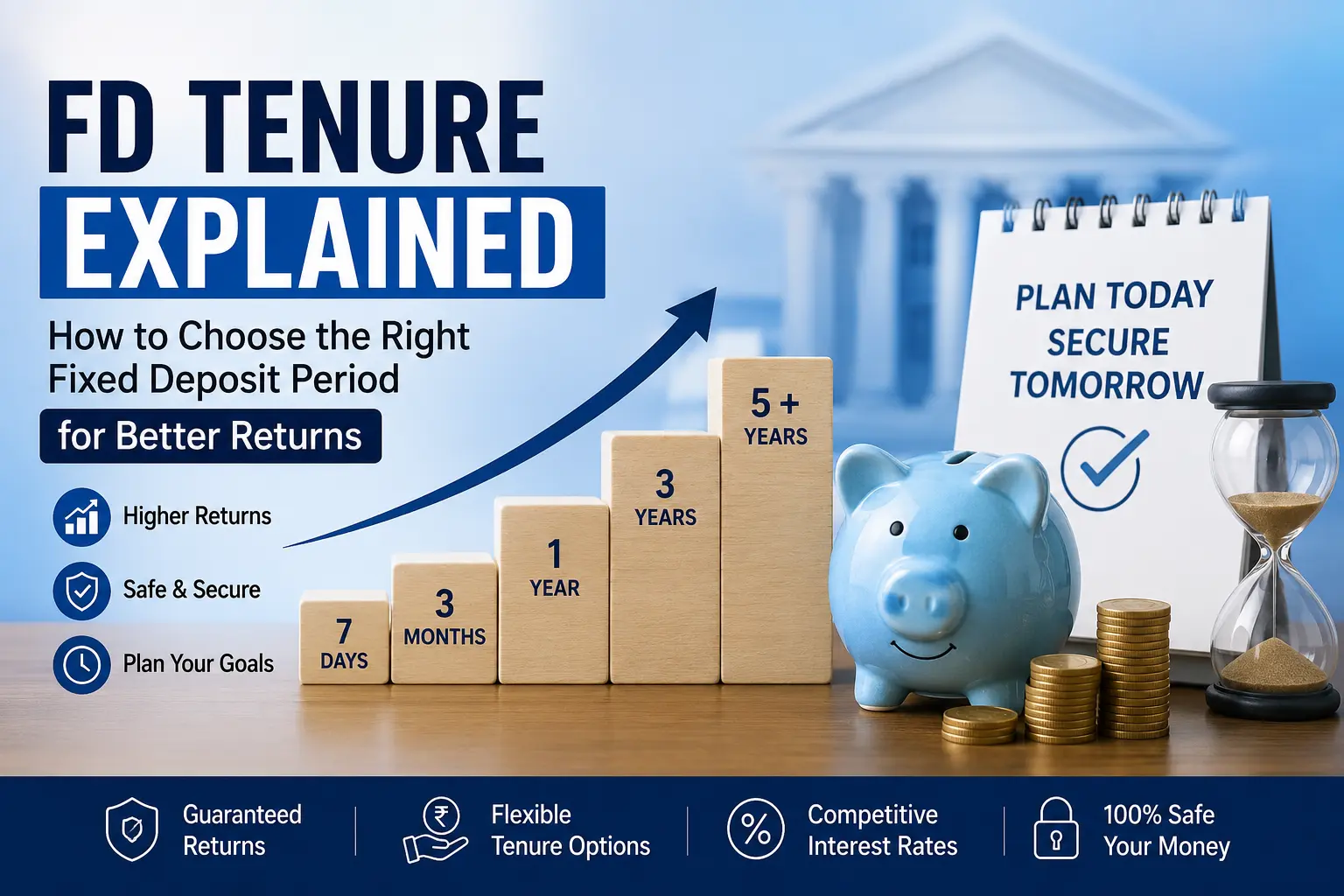
FD Tenure Explained: How to Choose the Right Fixed Deposit Period
fd tenure explained
Choosing the right FD tenure is just as important as choosing the interest rate. A bank offering the highest FD rate is not always the right choice if the tenure does not match your financial goal. Lock your money for too long, and you may face penalties or miss better rates later. Lock it for too short, and you may earn less than you could have.
This guide explains what FD tenure means, how it affects your returns, which tenure suits which financial goal, and how experienced investors use a strategy called laddering to balance returns with flexibility. By the end, you will know exactly which fixed deposit tenure fits your situation.
What Is FD Tenure?
FD tenure is the fixed period for which you deposit money with a bank or NBFC in exchange for a guaranteed interest rate. Once you choose a tenure, your money stays locked until maturity, unless you break the FD early and pay a penalty.
In India, FD tenure typically ranges from 7 days to 10 years, depending on the bank. Most banks offer flexible tenure choices in days, months, and years, allowing depositors to match the FD period with their exact financial timeline.
- Minimum FD tenure: 7 days (varies by bank)
- Maximum FD tenure: 10 years (varies by bank)
- Why it matters: Tenure determines liquidity, interest rate applicable, compounding benefit, and how well the FD matches your goal timeline
Banks generally offer higher interest rates for medium-term tenures (1–3 years) compared to very short-term or very long-term deposits, though this varies with the interest rate cycle. Choosing tenure without understanding this relationship is one of the most common mistakes FD investors make.
How Fixed Deposit Tenure Affects Your Returns
Tenure directly affects your final maturity value because of compounding. The longer your money stays invested, the more compounding cycles it goes through, assuming you do not break the FD early.
Consider a simple example. If you invest ₹1,00,000 at 7% annual interest with quarterly compounding:
- 1-year FD: Matures to approximately ₹1,07,186
- 3-year FD: Matures to approximately ₹1,23,144
- 5-year FD: Matures to approximately ₹1,41,478
Notice that the growth is not linear. This is the effect of compounding on maturity value. However, a longer tenure only benefits you if you do not need the money before maturity. Breaking an FD early usually reduces the effective interest rate and may attract a penalty, which can significantly cut into your returns.
There is also an opportunity cost to consider. If you lock ₹5,00,000 into a 5-year FD and interest rates rise significantly in year 2, your money continues earning the older, lower rate while new deposits earn more. This is called reinvestment risk, and tenure choice plays a direct role in how exposed you are to it.
To calculate your exact maturity value for any tenure and interest rate, use this FD Calculator.
Before selecting a tenure, compare the latest bank offers in our Best Fixed Deposit Interest Rates India 2026 guide to see which banks currently provide the highest returns.
Available FD Tenure Options in India
Indian banks generally structure FD tenure into the following slabs. Each slab serves a different purpose depending on your liquidity needs and return expectations.
| Tenure Slab | Typical Use Case | Liquidity | Expected Return Trend |
|---|---|---|---|
| 7–45 Days | Very short-term parking of idle funds | Very High | Lowest |
| 46–90 Days | Short-term goals, upcoming expenses | High | Low |
| 91–180 Days | Emergency fund buffer, quarterly planning | High | Low to Moderate |
| 181 Days–1 Year | Near-term goals, tax planning, bonus parking | Moderate | Moderate |
| 1–3 Years | Medium-term goals like vacations or down payments | Moderate to Low | Typically Highest |
| 3–5 Years | Tax-saving FDs, child education planning | Low | High |
| 5–10 Years | Retirement corpus, long-term wealth preservation | Lowest | High (but rate-cycle dependent) |
Note that the 1–3 year bracket often carries the highest interest rates in India’s banking system, since banks use this range to attract stable medium-term deposits. Always compare current rates before assuming longer automatically means better; you can check current offers on our page covering Best Fixed Deposit Interest Rates India 2026.
Which FD Tenure Is Best?
There is no single “best” FD tenure. The right tenure depends entirely on when you will need the money. Use this decision table to match your goal to a suitable tenure.
| Financial Goal | Recommended Tenure | Reason |
|---|---|---|
| Emergency Fund | 91 Days – 1 Year (laddered) | Needs quick access without heavy penalty |
| Vacation | 6 Months – 1 Year | Matches short planning horizon |
| House Down Payment | 1 – 3 Years | Balances growth with moderate liquidity need |
| Child Education | 3 – 5 Years (or matched to admission year) | Predictable, capital-safe growth for a known deadline |
| Retirement | 5 – 10 Years (laddered) | Long horizon allows higher compounding benefit |
| Wealth Preservation | 1 – 3 Years (rolled over) | Keeps capital safe while allowing periodic rate review |
| Tax Saving | 5 Years (fixed lock-in) | Mandatory lock-in under Section 80C tax-saving FDs |
If your goal timeline is uncertain, it is usually safer to choose a shorter tenure or use laddering rather than locking a large sum into a single long-term FD.
Short-Term vs Long-Term Fixed Deposits
Short-term and long-term FDs serve very different financial purposes. This comparison highlights where each performs better.
| Factor | Short-Term FD (Under 1 Year) | Long-Term FD (3–10 Years) |
|---|---|---|
| Returns | Lower, but flexible for reinvestment | Higher due to compounding over time |
| Liquidity | High | Low |
| Risk | Very low, capital protected | Very low, capital protected |
| Flexibility | Can reinvest quickly at new rates | Locked in, limited flexibility |
| Reinvestment Risk | Higher — need to reinvest frequently | Lower — rate locked for longer |
| Interest Rate Risk | Lower exposure to rate changes | Higher — miss out if rates rise later |
| Inflation Impact | Can adjust tenure as inflation changes | Real returns may erode if inflation rises |
| Best Investor Type | Conservative, near-term goal investors | Long-term, goal-based, retirement-focused investors |
To understand how compounding frequency affects both short and long tenures, see Compound Interest Explained for Beginners.
How Interest Rates Affect FD Tenure Decisions
The broader interest rate cycle, driven largely by RBI policy, should influence your tenure choice.
Rising Interest Rate Cycle: When rates are expected to rise, shorter tenures are generally smarter. This allows you to reinvest at higher rates once your FD matures, instead of being locked into today’s lower rate for years.
Falling Interest Rate Cycle: When rates are expected to fall, locking into a longer tenure now can help you secure today’s higher rate before banks reduce future offerings.
Stable Interest Rate Environment: When rates are relatively stable, tenure choice can be based purely on your goal timeline without worrying much about rate-cycle timing.
For example, if RBI signals a rate cut cycle and current FD rates are at 7.5%, locking ₹5,00,000 into a 5-year FD now protects that 7.5% rate even if rates drop to 6.5% next year. Conversely, in a rising rate environment, a 1-year FD lets you re-lock at a higher rate sooner.
FD Laddering Strategy
FD laddering is a strategy where, instead of investing your entire amount in one FD with one tenure, you split it across multiple FDs with different maturity dates.
Example: Instead of putting ₹5,00,000 into a single 5-year FD, you split it into five FDs of ₹1,00,000 each, maturing in 1, 2, 3, 4, and 5 years.
| FD | Amount | Tenure | Purpose |
|---|---|---|---|
| FD 1 | ₹1,00,000 | 1 Year | Liquidity and reinvestment at new rates |
| FD 2 | ₹1,00,000 | 2 Years | Balance of growth and access |
| FD 3 | ₹1,00,000 | 3 Years | Medium-term growth |
| FD 4 | ₹1,00,000 | 4 Years | Higher compounding benefit |
| FD 5 | ₹1,00,000 | 5 Years | Long-term growth and tax planning |
Benefits of Laddering:
- Regular access to a portion of your money every year
- Reduced reinvestment risk since not everything matures at once
- Ability to take advantage of rising interest rates gradually
- Lower need to break FDs early during emergencies
Use our FD Calculator to calculate the maturity amount for each FD in your ladder and compare different combinations.
Drawbacks of Laddering:
- More administrative tracking of multiple FDs
- Slightly lower average returns compared to locking everything at the best available long-term rate
- Requires more initial planning and calculation
Experienced investors often prefer laddering over a single large long-term FD because it balances the higher returns of long tenures with the flexibility of short tenures.
How To Choose the Right FD Tenure
Use this six-step framework to choose your FD tenure with confidence.
Step 1: Identify your financial goal. Are you saving for an emergency fund, a vacation, a house, education, or retirement? Your goal defines your timeline.
Step 2: Estimate when you’ll need the money. Match your FD tenure as closely as possible to this date to avoid premature withdrawal penalties.
Step 3: Compare bank interest rates. Rates vary across banks and NBFCs for the same tenure. Even a 0.5% difference matters on larger amounts.
Step 4: Check inflation. If expected inflation is close to or higher than your FD rate, your real returns may be minimal. Consider this alongside other investment options; see SIP vs FD: Which Investment Gives Better Returns in 2026? for a broader comparison.
Step 5: Choose compounding frequency. Quarterly compounding generally yields marginally higher returns than annual compounding for the same nominal rate.
Step 6: Review tax implications. FD interest is taxable as per your income slab. Understand this before committing large amounts; read FD Tax Explained: Is Fixed Deposit Interest Taxable?.
Real-Life Investor Examples
Scenario 1: 22-Year-Old Student
A student with ₹50,000 in savings and no immediate large expense should choose a short tenure of 6–12 months. This keeps funds accessible for unexpected costs like exam fees or laptop repairs while still earning more than a savings account.
Scenario 2: 30-Year-Old Salaried Employee
With a stable income and a goal of saving for a house down payment in 2–3 years, a 1–3 year FD or a laddered approach works best, balancing decent returns with eventual access to funds.
Scenario 3: 40-Year-Old Parent
Planning for a child’s college admission in 5 years, a 3–5 year FD aligned to the admission date ensures the money is available exactly when needed, with predictable, capital-safe growth.
Scenario 4: 55-Year-Old Retirement Planner
Nearing retirement with a 5–10 year horizon, this investor benefits from laddering across 3, 5, and 7-year FDs to build a retirement corpus while retaining periodic liquidity.
Scenario 5: Senior Citizen
A retired senior citizen relying on interest income should consider shorter to medium tenures (1–3 years) with a reinvestment or interest payout FD, since senior citizens typically receive a higher interest rate and may need periodic access to funds for medical or living expenses. Compare cumulative versus payout structures in Cumulative FD vs Reinvestment FD Explained.
Common FD Tenure Mistakes
- Choosing the highest tenure without a goal: Locking money for 10 years just because the rate looks attractive, without a matching financial need.
- Ignoring inflation: Assuming a 7% FD rate is always a “good return” without checking whether it beats inflation.
- Ignoring premature withdrawal penalties: Not checking the penalty clause before locking in a long tenure.
- Locking money for too long: Committing your entire emergency fund into a 5-year FD, leaving no accessible cash for emergencies.
- Breaking FDs repeatedly: Frequently breaking and re-booking FDs, which reduces effective returns due to penalties.
- Ignoring changing interest rates: Locking a large sum into a long tenure right before a rate hike cycle begins.
Frequently Asked Questions
1. What is FD tenure?
FD tenure is the fixed time period, ranging from 7 days to 10 years in India, for which your money stays deposited with a bank in exchange for a guaranteed interest rate.
2. What is the best FD tenure in India?
There is no universal best tenure. It depends on your financial goal, though 1–3 year FDs often offer the highest interest rates among common tenure options.
3. Is a longer FD tenure always better?
No. Longer tenures typically offer higher compounding but reduce liquidity and expose you to reinvestment risk if rates rise later.
4. What is the minimum FD tenure in India?
Most banks offer a minimum FD tenure of 7 days, though this can vary by bank.
5. What is the maximum FD tenure in India?
Most banks offer a maximum FD tenure of up to 10 years.
6. Which FD tenure gives the highest interest rate?
In most Indian banks, the 1–3 year tenure bracket typically offers the highest FD interest rates, though this varies with the current rate cycle.
7. Should I choose a short-term or long-term FD?
Choose short-term FDs for near-term goals and liquidity needs, and long-term FDs for goals more than 3 years away where higher compounding benefits you.
8. What happens if I break an FD before maturity?
Breaking an FD early usually results in a lower effective interest rate and may attract a penalty, typically 0.5% to 1% less than the applicable rate.
9. What is FD laddering?
FD laddering is splitting your investment across multiple FDs with different maturity dates to balance liquidity and returns.
10. Is FD laddering better than a single long-term FD?
Laddering offers more flexibility and reduces reinvestment risk, though a single long-term FD may offer marginally higher returns if rates remain stable or fall.
11. Should senior citizens choose longer FD tenures?
Not necessarily. Senior citizens often benefit more from medium tenures (1–3 years) with periodic access to interest income for living expenses.
12. Do senior citizens get a higher FD interest rate?
Yes, most Indian banks offer an additional 0.25% to 0.75% interest rate for senior citizens across most tenures.
13. What is the tenure for tax-saving FDs?
Tax-saving FDs under Section 80C have a mandatory lock-in period of 5 years.
14. How does interest rate cycle affect FD tenure choice?
In a rising rate cycle, shorter tenures let you reinvest at higher rates sooner. In a falling rate cycle, longer tenures help lock in current higher rates.
15. Can I choose different FD tenures for different banks?
Yes, spreading FDs across different banks and tenures is a common way to diversify risk and optimize returns.
16. What is the ideal FD tenure for an emergency fund?
A tenure of 3 months to 1 year, sometimes laddered, is ideal for emergency funds to balance easy access with reasonable returns.
17. Does compounding frequency depend on FD tenure?
Compounding frequency (monthly, quarterly, annually) is generally fixed by the bank rather than the tenure, though longer tenures benefit more from compounding overall.
18. How much does inflation affect long-term FD returns?
If inflation runs close to or above your FD interest rate over a long tenure, your real (inflation-adjusted) returns may be very low or negative.
19. Can I extend an FD tenure after booking it?
Most banks do not allow tenure extension mid-term; you typically need to wait for maturity and reinvest, or break the FD and rebook a new one.
20. What is the ideal FD tenure for retirement planning?
A laddered combination of 3, 5, and 7-year FDs is often recommended for retirement planning, balancing higher compounding with periodic liquidity.
Before investing, calculate your maturity amount with our FD Calculator, compare the Best Fixed Deposit Interest Rates India 2026, understand the basics in What Is a Fixed Deposit, and learn about taxation in our FD Tax Explained guide.
This article is for educational purposes only and should not be considered financial advice. Always compare bank interest rates and evaluate your financial goals before investing.


